Archivum
A proposal for an ideal writing system for native signers
July 17, 2026
Abstract
Despite many attempts to create writing systems for sign languages, there are no writing systems that are agreed upon among the communities of native signers since the existing writing systems are heavily researcher-oriented, resulting in cumbersome and time-consuming notation. To solve this issue, this thesis proposes an ideal writing system for native signers. Writing systems for spoken language are typologically analyzed to evaluate what kind of writing system is suited for native signers. This thesis argues that the ideal writing system may be an alphabetic syllabarial writing system just as Hangul only with phonological information. Since the proposed writing system is specifically designed for native signers, it is not well-suited for research use but rather everyday use for native signers.
Introduction
Writing is one of the most useful technologies that humanity has ever invented. By writing down, people are able to store information and convey their thoughts to others possibly across millennia. Although communities of spoken languages utilize various types of writing systems varying from syllabary to logography, communities of native signers lack writing systems that are commonly agreed upon and easy to use. The majority of existing writing systems for sign languages are heavily researcher-oriented. Even if a system is not researcher-orientated, it is not easy to use as it is impossible to write it by hand or use it on digital devices. No essays, no notes, no grocery list, no messaging on phone, and no textbooks. This leads us to the research question of this thesis: What is an ideal writing system for native signers? This thesis aims to investigate this question by analyzing properties that writing systems of spoken languages exhibit and problems that existing writing systems are faced with.
This section is immediately followed by theoretical background in chapter 2 in order to provide sufficient information to understand the problems that the existing writing systems for sign languages share and the properties that are utilized in the proposed writing system to solve these problems. The proposed writing system will be introduced and its properties will be discussed in chapter 3. Thereafter, advantages and disadvantages of the proposed writing system will be analyzed by comparing writing systems for sign languages in chapter 4. In order to evaluate whether the proposed writing system has been able to solve the problems, all the information presented in this thesis will be summerized in chapter 5. As it is not possible to list all the graphs of the proposed writing system comprehensively, the complete list of graphs will be presented in the appendices.
Theoretical background
This chapter provides information required to understand what type of script is suited and which features are indispensable and dispensable for the script of sign languages. Firstly, the terminology required to understand subsequent chapters will be discussed. Additionally, the typology of writing systems for spoken languages will be described, which will be helpful to understand which category the writing system proposed in this thesis falls into and what kind of features are utilized. Finally, after a short overview of basic properties of sign language phonology, three of the existing writing systems for sign languages and the problems that they are faced with will be discussed, so that it will become clear whether these problems are solved with the writing system proposed in the subsequent chapter.
§ Elements of writing system
In this section, core grapholinguistic terms such as grapheme and allograph are defined. Thereafter, information on the direction of writing is provided. Lastly, the medium of writing is discussed in order to argue the importance of Unicode.
§§ Grapheme
Even though scripts may seem so diverse that there might not be any commonalities among them, there certainly are generalizable elements. The minimal unit of the writing system is a grapheme. Despite many scholars' attempts to define what a "grapheme" is, their definitions were usually alphabetocentric and lacked cross-linguistic applicability (Meletis, 2019). Meletis, however, proposed criteria that are cross-linguistically applicable, which are as follows: "The grapheme can be defined as a basic unit of writing that (1) distinguishes meaning, (2) has a linguistic value (typically by referring to a linguistic unit), and (3) is minimal in that it is not composed by smaller units which are themselves graphemes” (Meletis, 2019: 43).
In this framework, all of these three criteria are to be met in order to be classified as a grapheme: when one or two of these criteria are met, it is not sufficient to be classified as one grapheme.
To evaluate whether or not the first criterion is fulfilled, a minimal pair is utilized. In order to ascertain whether <a> [Note: The angle brackets “<x>” are used to signify that the content of the brackets is one or more graphemes.] is a grapheme or not, it has to be substituted by another basic shape, for example, by <o> in the English word, <lag>, which becomes <log> after the substitution, which is an existent English word. It, therefore, shows that <a> and <o> fulfill criterion (1).
For criterion (2), Meletis (2020) further explains that linguistic value is required in order to discern the difference between a grapheme and a polysegmental grapheme: for example, <k> is a grapheme in German since it can differentiate words such as in <kochen> and <lochen> but |c| [Note: The vertical bars “|x|” are used to signify that the content of the bars is one or more subsegments of a grapheme. This includes a basic form and a graph whereas the double vertical bars “||x||” are used to signify that the content of the bars is an interinventory allograph.] is not, even though it may appear to have a linguistic value because it can differentiate words such as in <recken> and <renken>. |c|, however, fails to fulfill the second criterion; |c| can never occur without <k> or <h> in native Standard High German [Note: <c> can appear without <h> or <k> in certain varieties of German.] words. With criteria (1) and (2), it would entail that <sch> and <ng> in German are graphemes. They, however, are not in this framework. The cause will be clear with criterion (3).
For criterion (3), the minimality is required in order to discern the difference between a polygraphemic multigraph and a polysegmental [Note: For example, |c| in Standard High German is a basic shape of a polysegmental grapheme.] grapheme. For example, <sch> clearly meets criterion (1) and (2); it may participate in a minimal pair (e.g., <schellen> and <bellen>), and it has a linguistic value (a phoneme /ʃ/) but it is a multigraph, specifically a polygraphemic trigraph, and already consists of two graphemes, <s> and <ch>. This is also applicable to <ng>; even though it may form a minimal pair and has a linguistic value of /ŋ/, it consists of <n> and <g>, each of which is already a grapheme on its own.
§§ Allograph
Additionally, there is a subsegmental concept to a grapheme: a graph. This is a minimal unit that is a visual representation of (or a basic shape/part of polysegmental) graphemes and that is distinctive enough to be differentiated from the others. This entails that the single-story [Note: Single-story as in “one floor”; it is postulated that the first curved horizontal line from the bottom is the ground floor and the second is the second floor. Double-story as in “two floors”. It is two floors since there is an extra curved horizontal line, which is postulated to be the second floor.] |ɑ| shown in Figure fig:onestorya and the double-story|a| shown in Figure fig:twostorya are two different graphs (Meletis, 2020). Although they represent the identical grapheme, they are visually distinct. It also implies that <a> in different fonts and/or in different cases are individual graphs: roman ||a||^2 (not italic), italic ||a||, bold ||a||, and italic bold ||a||, and the majuscule variant in those fonts, ||A||, ||A||, ||A|| and ||A||. The graphs that belong to the identical grapheme are called allographs.
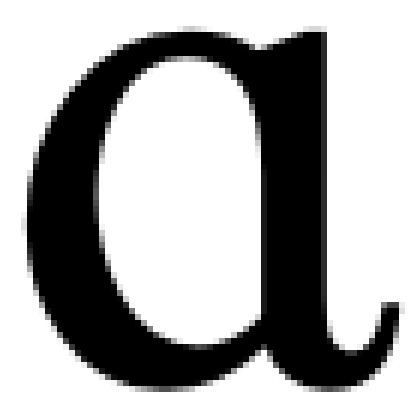
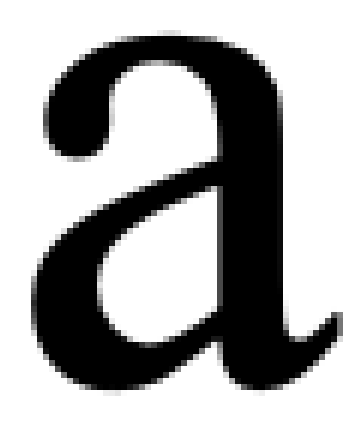
Allography is a concept that can draw a parallel to allophony (Meletis, 2020); allophones of a phoneme are auditorily realized distinct forms of the same abstract unit, and allographs of a graph are visually materialized different forms of the same abstract unit. More specifically, the variant graphs in the same font are called intrainventory allographs whereas allographs across different fonts and/or font families are called interinventory allographs, as shown above. A positional variant of a grapheme is called intrainventory positional allographs. Meletis (2020, §4.2) provides an example of the intrainventory positional allograph: the pronoun “you” in Greek is <σας> (/sas/ 2nd pers. pl. gen./acc.). Although the onset and the coda of the word are the same phoneme and grapheme, the graphs are different. It is because <ς> can only occur in the word-final position as they are complementarily distributed. Thus, the two never participate in a minimal pair.
§ Typology of writing systems
In this section, a typological overview of writing systems is provided. In each subsection, general information and structure of each type of writing systems are discussed first. Subsequently, cognitive aspects of each type of writing system are discussed, which will be utilized for determining which features of writing systems should be present in the writing system for native signers.
§§ Alphabet
The alphabet is by far the most common writing system. The most notable feature of this type of script is that both vowels and consonants are written down. The major writing systems that utilize the alphabetic system are the Latin/Roman script, the Cyrillic script, and the Greek alphabet.
Ellis et al., (2004) argue that the alphabetic script is easier to learn than the syllabic (§ 2.2.3) or iconic (§ 2.2.4) writing system due to the smaller inventory of graphs, although the extent to which cognitive load is required for the alphabetic script varies by the orthographic depth. Regarding the alphabetic script, the authors further explain that children can more easily decipher words in languages with shallow orthography (high phoneme to grapheme mapping consistency) like Finnish or Spanish, whereas children have a much harder time deciphering words in languages with deep orthography (low phoneme to grapheme mapping consistency) like English.
Deep orthography, however, also comes with its advantage: Fruchter et al. (2013) argue that the language faculty in the human brain seems to prioritize the underlying form over the surface form when reading. This entails that even though English orthography exhibits some inconsistency, such as the past tense form for asked, which, in the surface form, is pronounced as /ˈæskt/ or even /ˈæst/ in certain dialects of English, the cognitive load is lighter when it is written <asked> rather than <askt> or <ast>. These findings provide a foundation for discussion of indispensable features for the proposed writing system in § 3.1.
§§ Abjad
Abjad has the striking feature of omitting vowels altogether and simply writing only consonants. For this feature, it is suited for languages whose phonologies do not display a wide range of vowel qualities since it would be impossible to perform phonological reconstruction. A script that utilizes abjad is the Phoenician script. The Phoenician script is a pure abjad having no grapheme for any vowels, whereas in the Arabic and the Hebrew script, long vowels are written and even short vowels can be written although the use of short vowel graphemes is limited to children’s book and materials for L2 learners [Note: There are few instances where short vowels can be written, for example, for loan words or words that are unclear even with context.]. As it may not be evident how it works, an English sentence without vowels is shown in the following example.
Example: Ths nglsh sntnc s wrttn wtht vwls.
Although parsing this example might have been affected by priming (preceded by almost the same sentence), it is likely that this was not hard to decipher. However, this priming effect can take place by having the context and texts are rarely written without context. Even though abjad scripts have the obvious disadvantage of lower decipherability than an alphabetic script, they have their own merits. Share et al (2017) argue that skilled readers can rapidly process words heavily relying on top-down processing with morphological and syntactic information without any vowels that would change the visual shape of words. It can therefore be argued that skilled readers are not only able to accurately guess the correct words but that phonological reconstruction is actually unnecessary, which, as Fruchter et al. (2013) argue, takes longer to process than morphological decomposition, although the claim by Fruchter et al. for the allomorphy may not be generalizable to the homography (see further discussion in § 3.1)
§§ Syllabary
A syllabary is a writing system where an entire syllable/mora is predominantly written as one graph. Even if two graphs have the identical onset, they are unlikely to resemble in shape. For example, /ka/ and /ki/ in the Japanese script Hiragana do not share any visual features as shown below in Figure fig:ka and fig:ki.
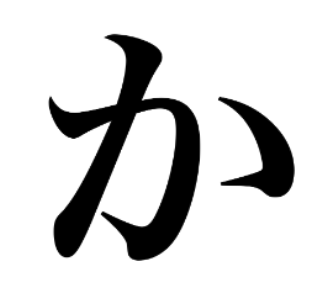
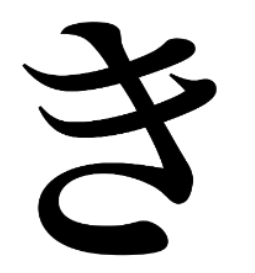
Therefore, syllabaries have the tendency to have a large inventory of graphs in the system. Since having one more phoneme in the phonology of a language significantly increases the number of graphs required in the inventory, a syllabrial system is suited for languages with a low inventory of phonemes and a simple syllable structure; if a language has a /CV/ structure and 10 phonemes for /C/ and /V/ each, it means that the system needs 100 graphs at least. For /CVC/, it will be 1000 graphs. Scripts that use syllabaries include Hiragana and Katakana for Japanese, and Canadian Aboriginal Syllabics of the Algonquian, Eskaleut and Athabaskan language families. Despite their disadvantageous large inventories of graphs, syllabaries have the advantage that they do not require as much space per graph as an alphabetic system as shown in Figure fig:kamo. Recall that it is not the case that certain parts signify consonants or vowels as they are not compositional.
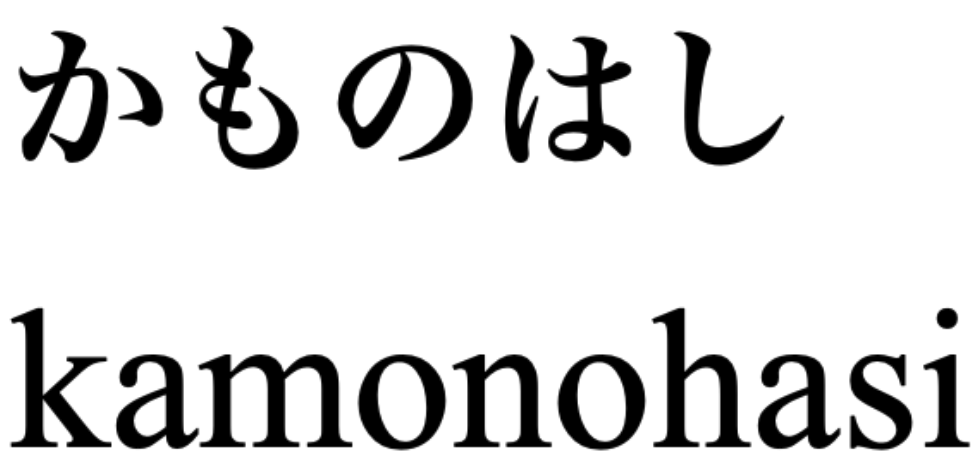
This, however, is not an inherent feature of a syllabarial system. Unlike Hiragana, other systems simply configure a syllable into one coherent letter as demonstrated in Figure fig:hansyllable.
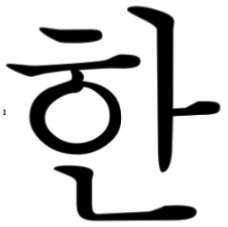
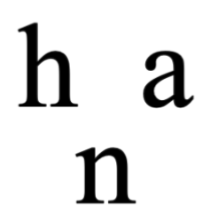
A script that is configured in the manner shown on the right, which has such a feature is the Korean writing system, Hangul. It is considered as an alphabetic syllabary. Since it is compositional, the inventory of graphemes is smaller compared to a true syllabary. Combinations of consonants and vowels in syllables do not have to have distinct shapes but are rather stacked together. Ju et al., (2022) argue that having graphemes of a syllable configured in such a manner makes the decomposition process faster than the same grapheme placed in a linear manner, which will be relevant for the proposed writing system.
§§ Iconic writing system
Figure fig:d is an example of a logograph in the Han script, which is a graph
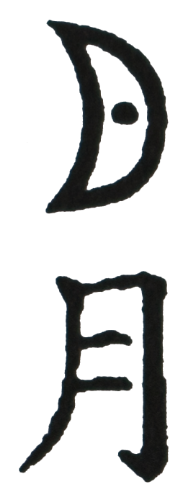
that represents a morpheme rather than phonological information. This logograph is specifically a pictograph, which is a graph derived from the shape of the corresponding object. At first, people draw the object, in this case the moon, and with time, strokes are modified to be distinct from other graphs and to be easy to handwrite.
§ Unicode
Although it may vary from culture to culture to a certain extent, the traditional medium of writing is a pen and paper. Some people may prefer to take handwritten notes. However, it is indisputable that modern society does not function without being able to type texts on digital devices: no emails, no websites, no messaging, and no digital notes. It may seem simple what happens when a key is typed and a graph appears on a screen. Since keeping data in a digital format requires the data to be converted into numbers (ultimately in binary for computers), every graph from a countless number of writing systems has to be associated with a set of numbers. <A> is associated with <0041> and <б> (second grapheme in lowercase in the Cyrillic script) is associated with <0431>. By simply assigning a set of numbers to every grapheme in the writing systems, Unicode allows users to type any grapheme on any digital device, as long as the grapheme is listed in Unicode. This is possible because virtually all the operating systems use unicode as an encoding standard. In order for a writing system to be listed in Unicode, a proposal can be sent to the Unicode Consortium.
§ Phonology of sign languages
Before discussing the existing writing systems for sign languages, we first need to provide a short overview of some aspects of sign language phonology leaving aside nonmanuals (NMs). NMs are utilized throughout sentences on a various levels - from phonological to syntactic level. Since it is impossible to list and discuss all the functions of nonmanuals in this section, they will not be discussed in this thesis.
Research on various sign languages has demonstrated that signs are not holistic units, but are made up of smaller parts, the so-called parameters. The phonology of sign languages consists of three major parameters: hand configuration, location, and movement. Inventories of phonemic handshapes vary from sign language to sign language just as inventories of phonemic consonants for spoken languages are diverse.
§§ Hand configuration
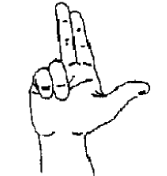
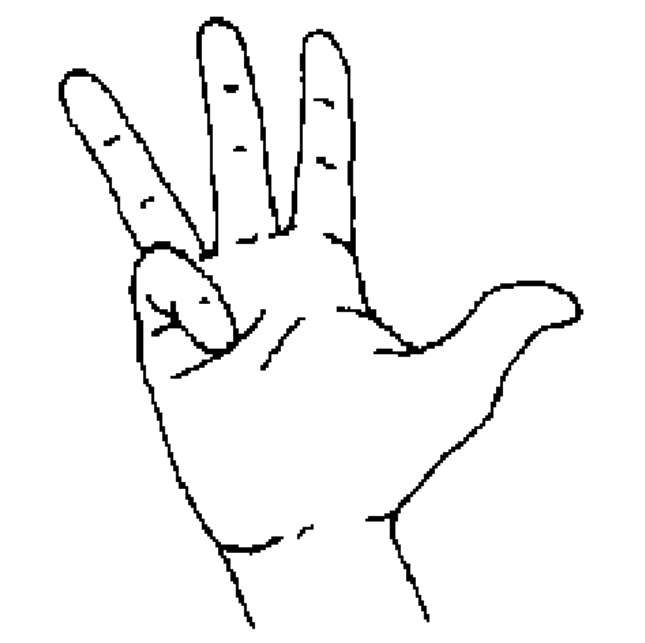
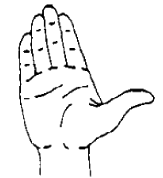
Handshapes shown in Figure fig:f certainly appear different from one
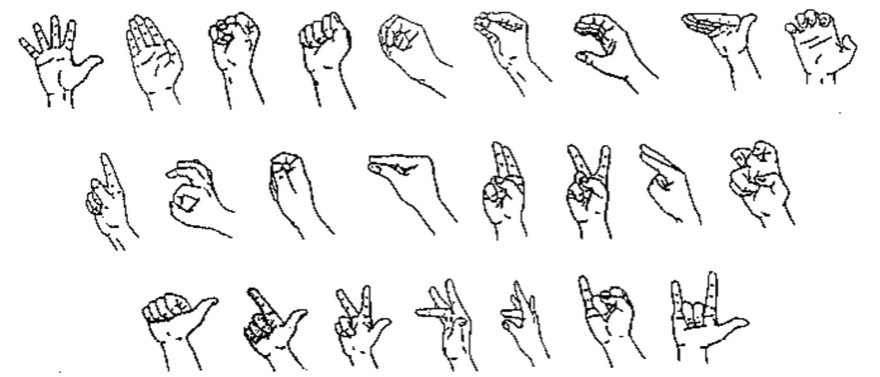
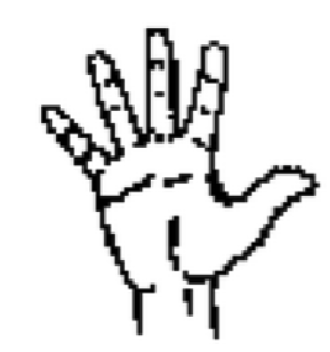
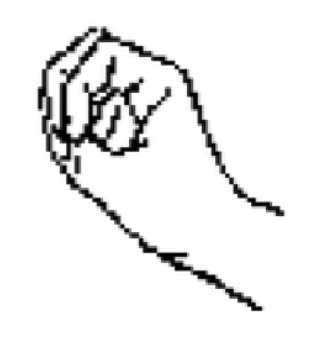
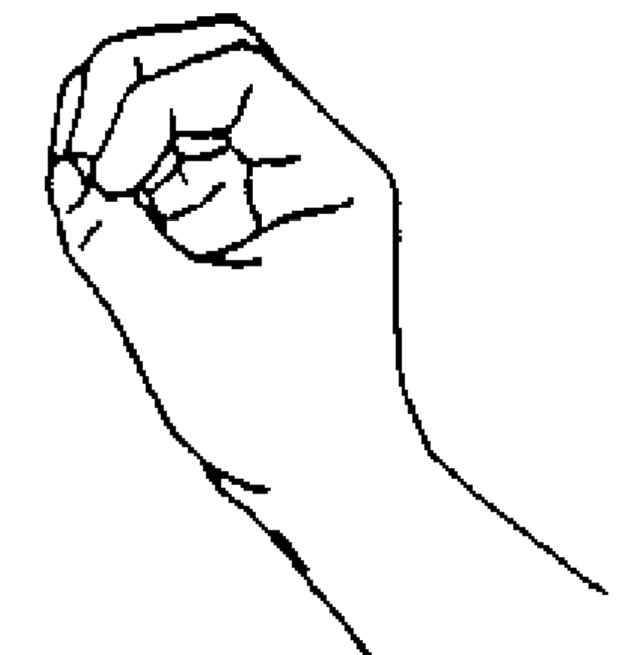
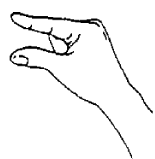
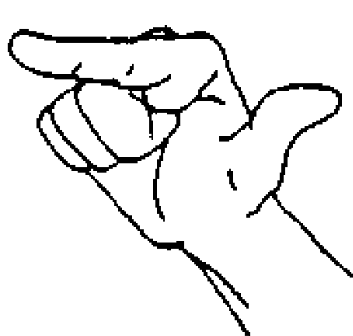
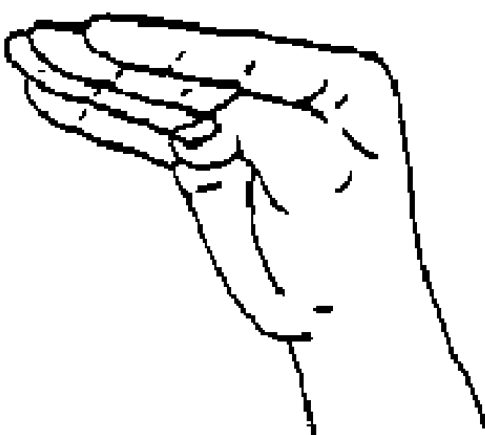
another even without the knowledge of phonology of sign languages. However, the hand configuration parameter is said to be the most complex of the major parameters, as the hand has many degrees of freedom (Lillo-Martin & Sandler, 2008). In order to phonologically analyze the hand configurations, fingers need to be sorted into two categories: selected fingers and unselected fingers. This is because the hand configuration category consists of one or more selected fingers configured in a particular position and orientation (Lillo-Martin & Sandler, 2008). The selected fingers are configured with three major components: flexion, aperture, and width. For the category of flexion, the selected fingers can be [extended] or [curved], for the category of aperture they can be [open] or [closed], and for the category of width, they can be [spread] or not spread. Since they are independent categories, those categories can be combined. For example, they can involve features, [extended] and [spread], to make a "5" hand shape shown in Figure fig:5hand, and closed and curved to make an "O" shape shown in Figure fig:ohand.
Moreover, handshapes can change during the articulation of the sign (internal movement) by changing the aperture or the flexion. For example, in the sign NO in ASL, selected fingers (thumb, index, and middle finger) are [extended] and [open] at first but by the end of the sign, the aperture of the selected fingers changed to closed.
A subcategory of the hand configuration is the orientation. The orientation is usually analyzed with the direction of the hand or the selected fingers relative to the major location. This includes [ulnar] (thumb side), [radial] (pinky side), [fingertip], [palm], and [wrist]. For example, in the sign POLICE in NGT the orientation can be analyzed as [ulnar] as the thumb side of the hand is facing the major location, head.
§§ Location
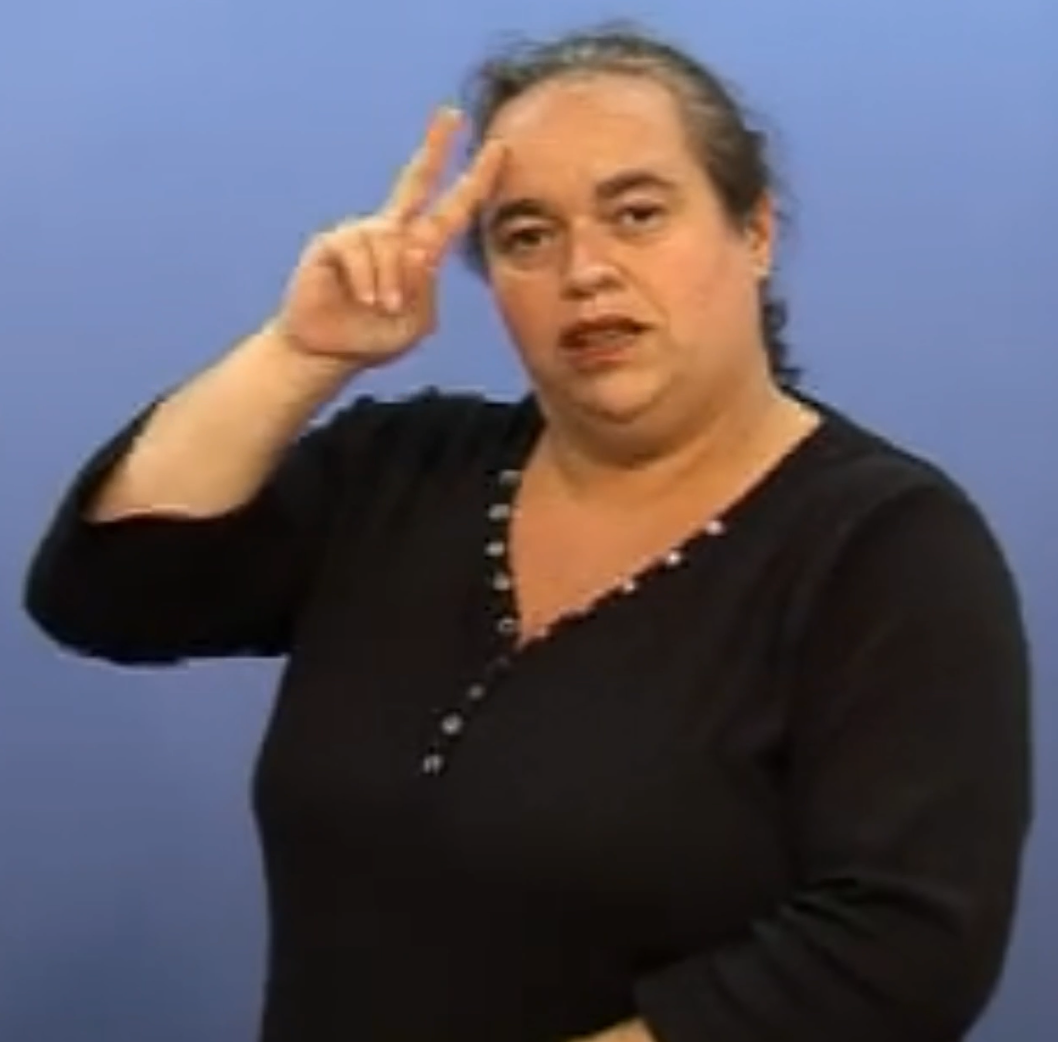
A sign is articulated only in one major location. Van der Hulst & van der Kooij (2021) claims that in order to comprehend the location parameter, its notion needs to be divided into two components: a major location unit and a setting unit. Even if a sign involves a movement where the hand moves from a location to another (a path movement), the hand remains within the major location. For SERIOUS shown in Figure fig:serious, even though the hand moves from the forehead to the chin, the hand remains within the major location, head. Therefore, this movement can be interpreted as a path movement articulated from high ([hi] ) to low ([lo] ) (setting) in [head]. The major location includes [body], [arm], [neck], [neutral space], and [hand].
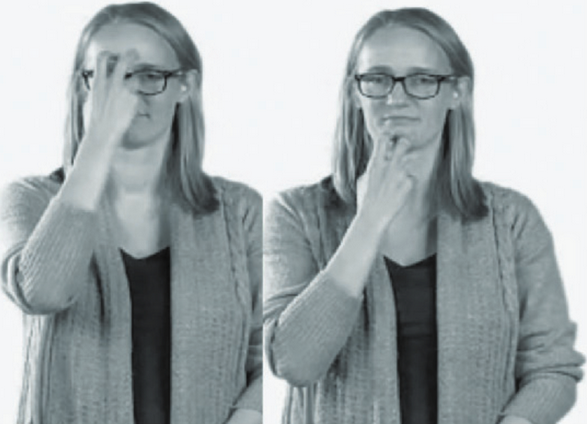
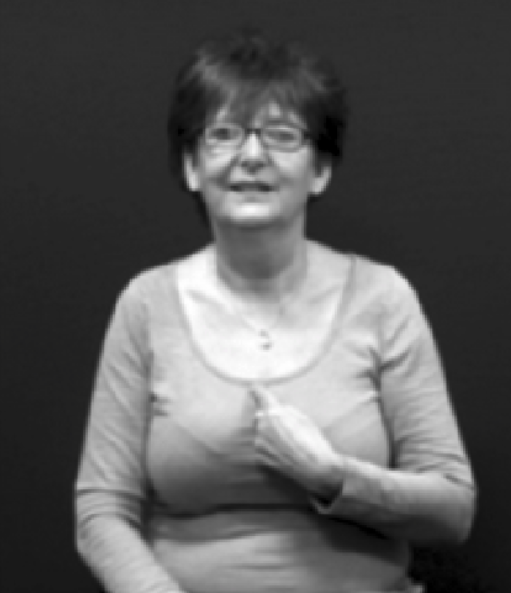
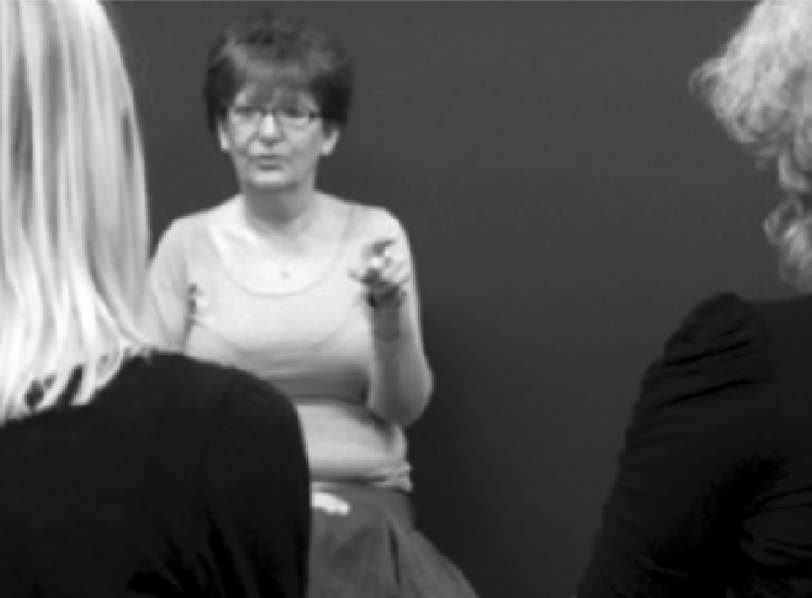
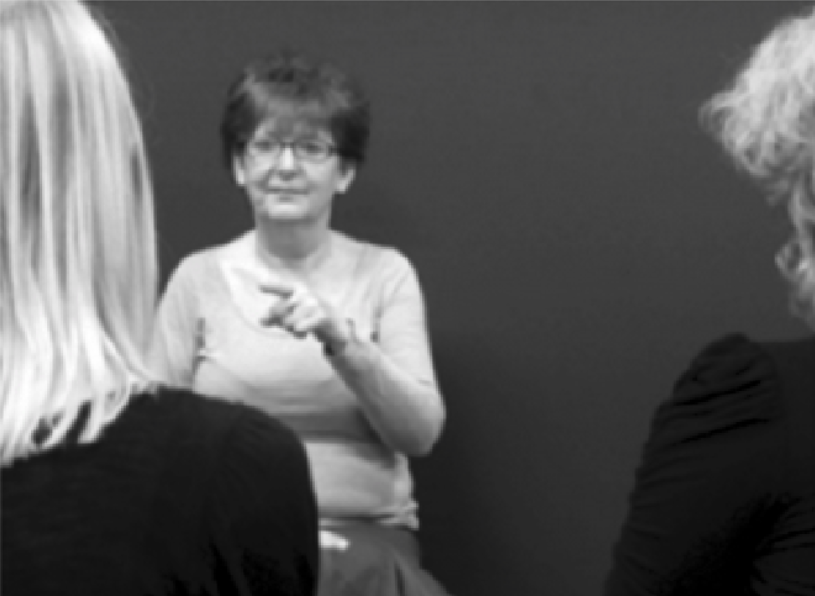
Location also plays a significant role in personal pronouns. Personal pronouns are generally realized in the form of pointing signs as illustrated in Figure fig:pronoun. In order to sign the first person pronoun "I", the signer simply points towards her chest. For the second person pronoun, the signer points at the interlocutor. For the third pronoun, if the referent is present, the signer points towards the referent. Otherwise, a signer will point towards empty space (spatial locus), which can be referred to again later in the conversation. The spatial locus is also utilized for agreement in certain types of verbs (more details in the next section).
§§ Movement
Movements come in two types, as path movement and local movement respectively, as shown in the overview provided by van der Hulst & van der Kooij (2021) in the following example. Example:Types of movement: • Path movement • Local movement •Aperture change (hand-internal movement) •Orientation change
The path movement is a movement that one or both hands move from one location to another. Moreover, (a) and (b) can occur independently. Moreover, they can occur simultaneously, entailing that three combinations are possible: (a.) and (b.i.), (a.) and (b.ii.), or (a.) and (b.i.ii.).
For path movement, Sandler (1989) proposes types of path movements alongside her framework. While a path movement that draws a straight line is the most common, the shape of the path movement can also be [circular], [curve] or [zigzag] (van der Hulst & van der Kooij, 2021).
§§ Two-handed signs
Signs can be either one-handed or two-handed. To sort these signs by types of movements, Battison proposes 4 types of movement shown in the following example (1978; Eccarius & Brentari, 2007: 1172). Example: Battison’s four types of signs: Type 0: one-handed signs Type 1: two active hands with the same handshape performing the same movement (synchronized or alternating) Type 2: two-handed signs with one active and one passive hand, both with the same handshape Type 3: two-handed signs with an active and a passive hand, each having a different handshape
Type 0 refers to one-handed signs and types 1-3 refer to two handed-signs. The example of type 0 is SERIOUS shown in Figure fig:serious discussed in the previous chapter. These types 1-3 can be divided into broader categories (van der Hulst & van der Kooij, 2021): symmetrical and asymmetrical. If the non-dominant features the identical handshape as the dominant hand, the sign is symmetrical (types 1 or 2). Otherwise, it is asymmetrical (type 3).
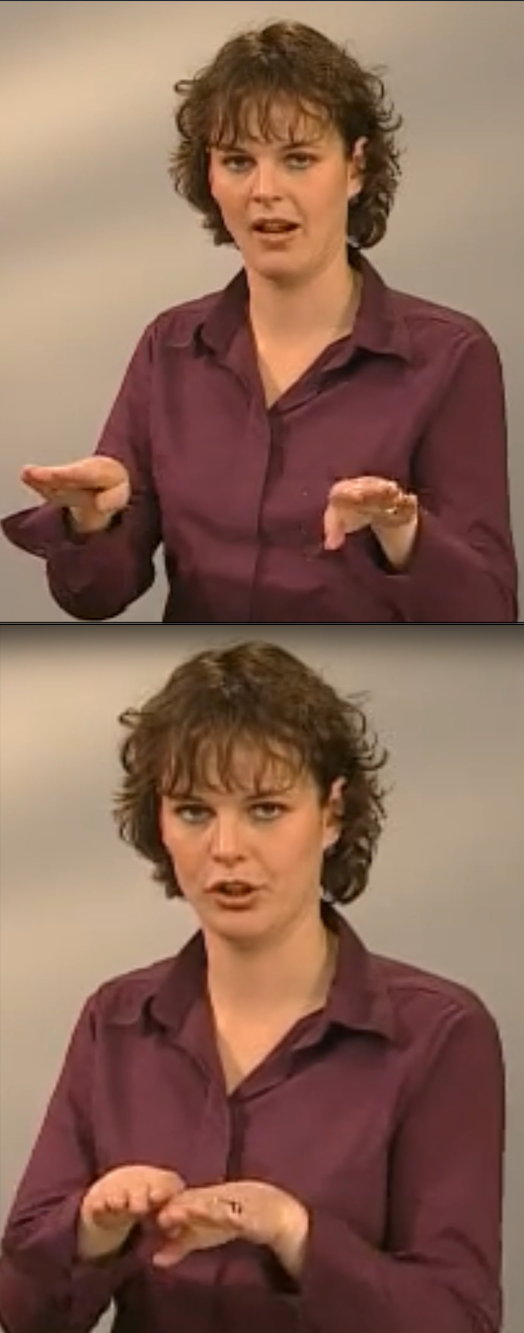
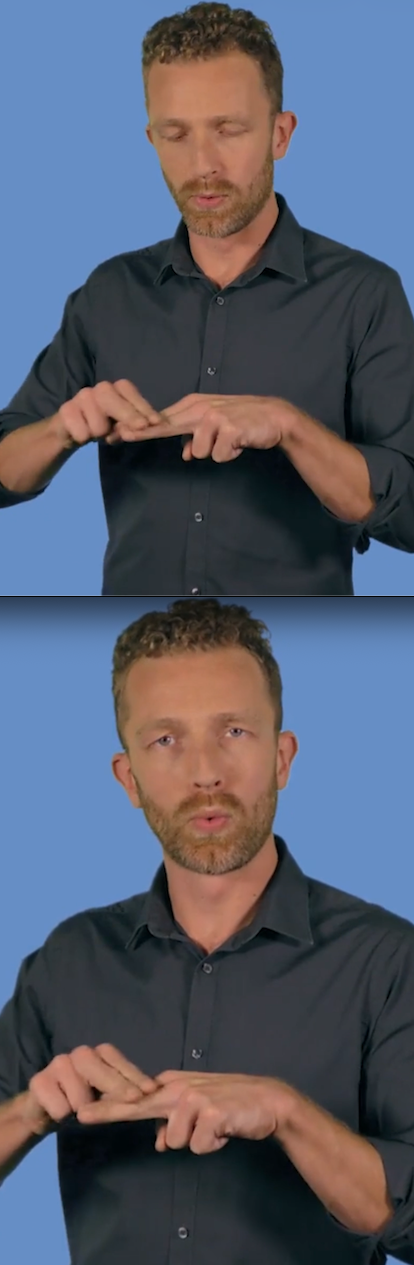
The notable part of type 1 is that it can be either synchronic or alternating as shown in Figure fig:l. For the synchronic signs, two hands moves in sychronization, illustrated by the NGT sign SAME in Figure fig:same.2signs
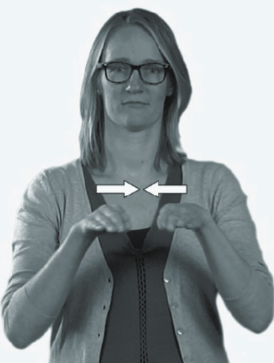
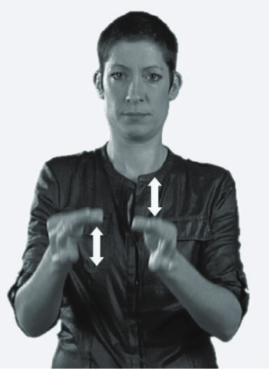
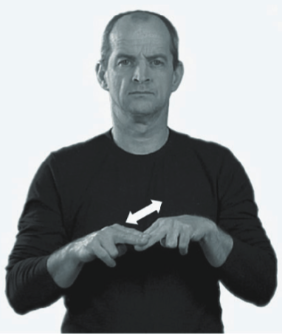
For the alternating sign, even though the movement in both hands are identical, the timing in two hands is not in synchronization as shown in the example JUDGE in Figure fig:judge.2signs.
For type 2 signs, even though the handshapes of two hands are identical, the non-dominant hand does not involve any movement. This is illustrated by the NGT sign GREEN shown in Figure fig:green.2signs. The dominant hand moves on the non-dominant hand which remains stationary.
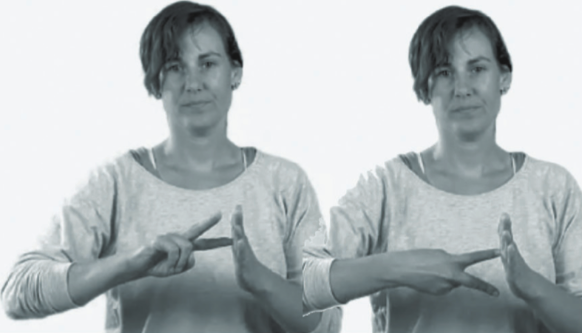
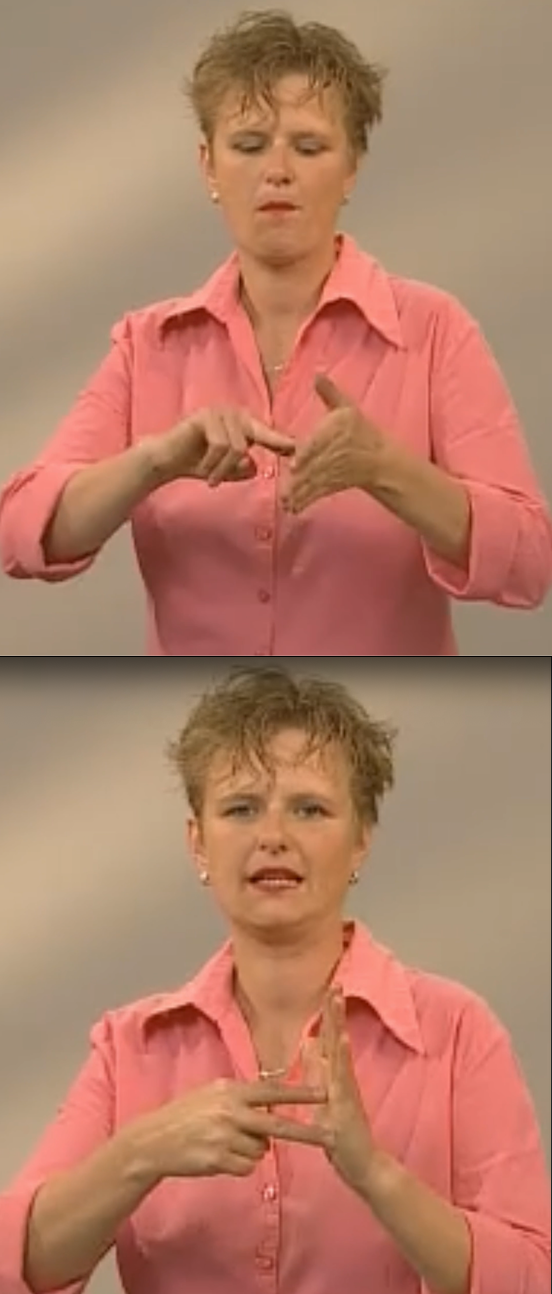
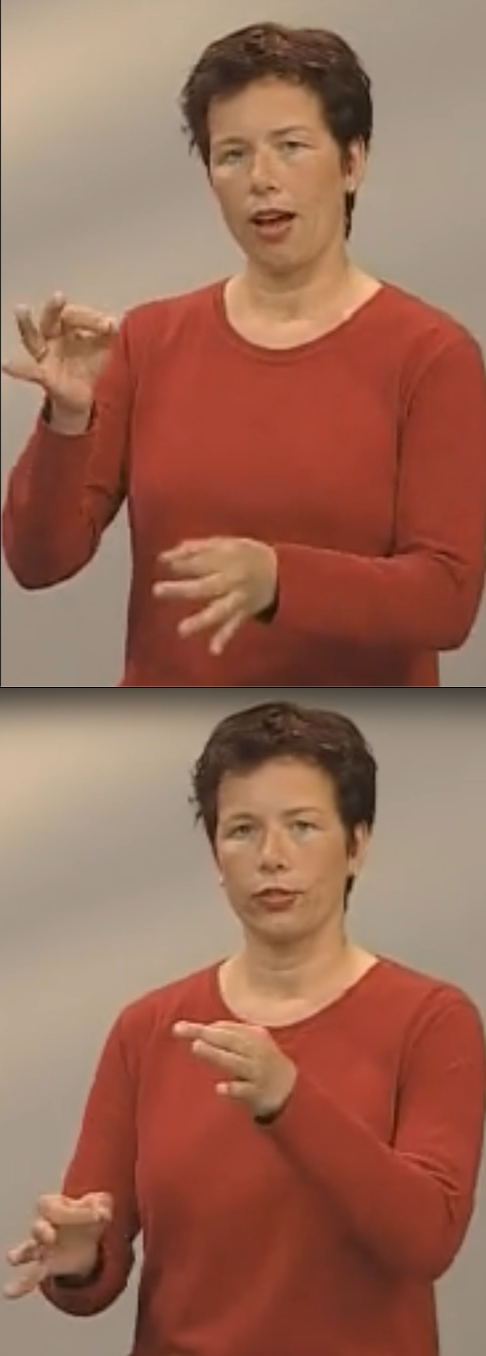
For type 3 signs, the dominant hand moves on the non-dominant hand just as in type 2 signs. The difference between type 2 and type 3 is that only type 3 sign are asymmetrical, illustrated by the NGT sign POLITICS shown in Figure fig:politics.2signs. In POLITICS, the dominant hand features a "v" shape and the non-dominant hand is a flat hand. A flat hand belongs to a set of unmarked handshapes (Battison, 1978) as the non-dominant hand in type 3 signs can only feature one handshape from a set of unmarked handshapes (dominance condition).
The conditions of type 2 and type 3 signs entail that the non-dominant hand may move only when the sign is symmetrical (symmetry condition) (Battison 1978).
Battison’s four types of signs will be highly relevant in the next chapter, since the handshape of the non-dominant hand is transcribed in the proposed writing system with the aid of this categorization (see § 3.2.4).
§ Existing writing systems for sign languages
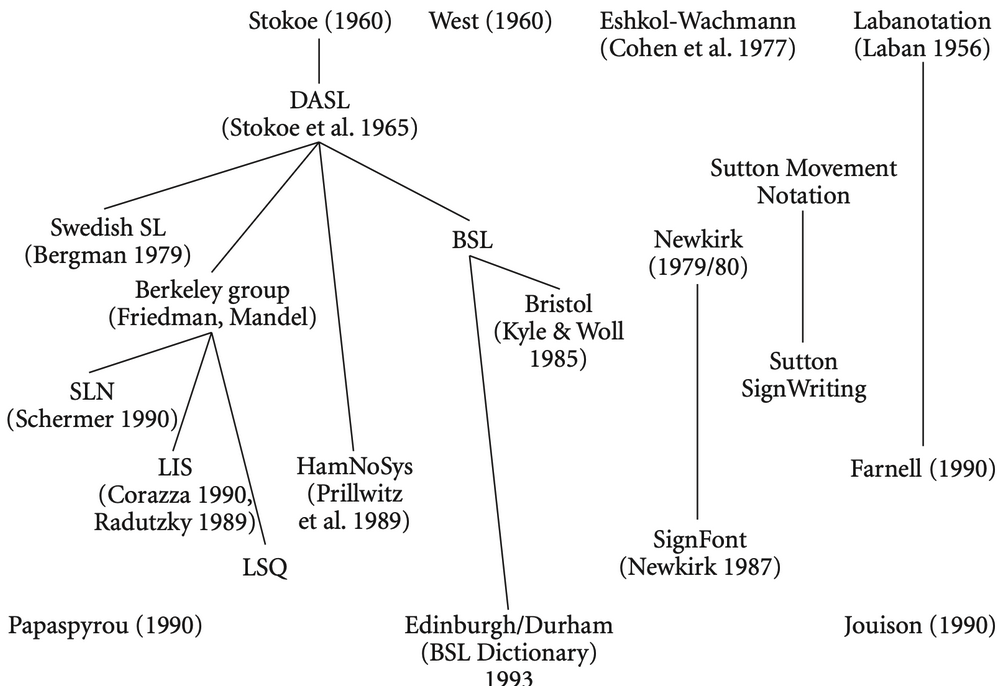
There have been many attempts to transcribe sign languages shown in Figure fig:m. Only a few of them can be called successful, which will be discussed here in the this section. In each subsection, general information about selected systems and an explanation of their structure will be provided, with an example transcription for one and the same ASL sign.
§§ Stokoe's Notation System
Stokoe notation was developed by William Stokoe in the 1960s (Stokoe, 1960). It was modified by researchers at the University of California at Berkeley, and further modifications were made by European researchers to adapt it to other sign languages (Miller, 2001). The structural template for a sign is shown in Figure fig:stokoe. Stokoe (1960) proposes terms for the three parameters: tabula (tab) for location, designation (dez) for handshape, signation (sig) for movement. The sign CHILD in American Sign Language (ASL) shown in Figure fig:child,
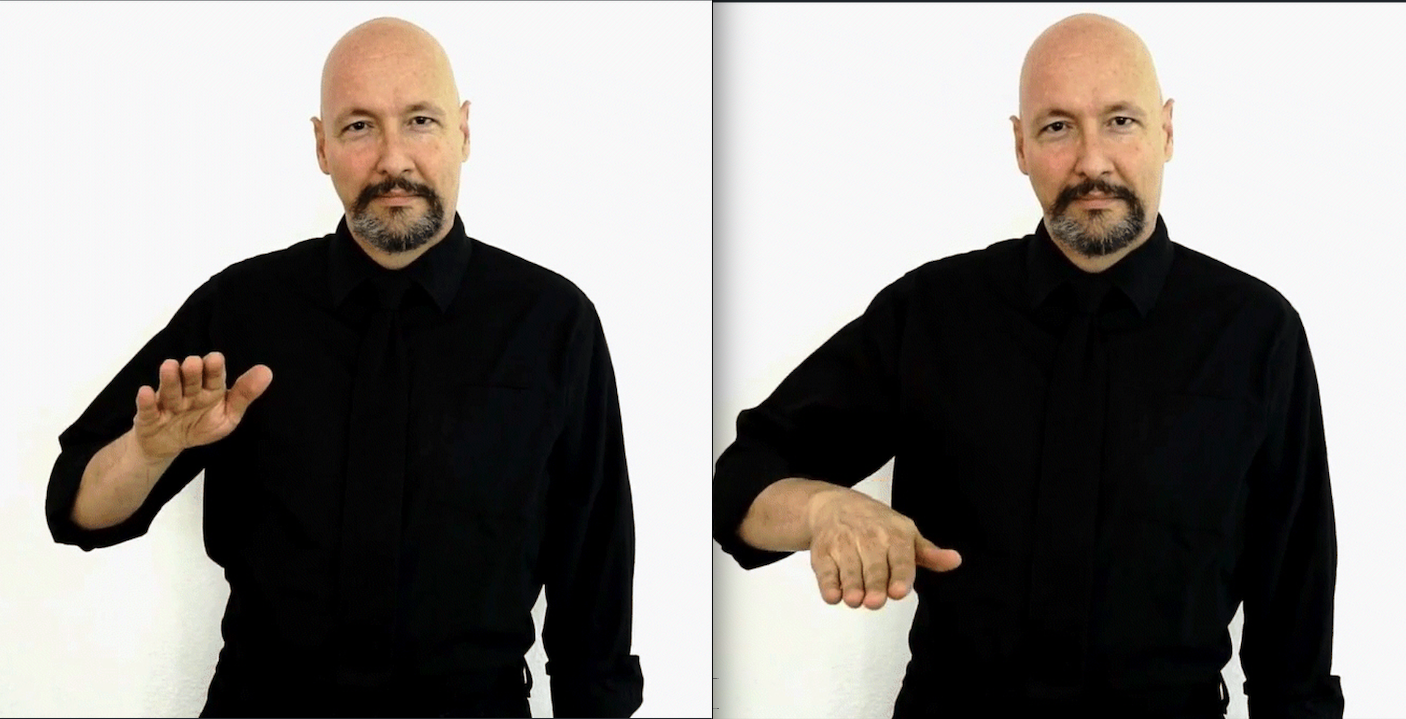
as written in Stokoe’s notation system is shown in Figure fig:stokoe below. The omission of tab signifies that the sign is articulated in the neutral space though it can also be written as <Ø>. <5> signifies that the handshape is a spread hand as in 5 in ASL. <v> in the superscript signifies that the signation is a downward movement and the adjacent <•> signifies that the movement is repeated. The upside down <ɑ> signifies that the orientation of the palm is downward.
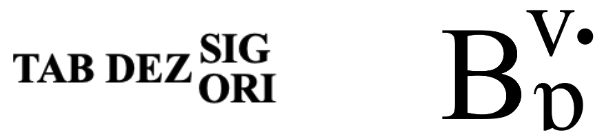
Miller (2004) argues that the advantages of having an inventory of graphs that are largely based on the Latin script and its diacritics, was that it has a mnemonic function. However, handshapes used for sign language differ from country to country, which causes interlinguistic inapplicability. This can easily be substituted by iconic graphs derived from the actual shapes of hands, movements, and body parts without losing mnemonic functions just as iconic graphemes in Hangul. The writing systems that have extensive use of such a feature are presented in §§ 2.5.2. and 2.5.3.
§§ HamNoSys
Hamburger Notations-System (HamNoSys) is a writing system developed at the University of Hamburg in the 1990s. It has extremely high grapheme-phoneme correspondence, and all the graphs were developed specifically for the script and are iconic to a varying degree. Note that they are not logographic despite the iconicity of graphemes: logographs represent words themselves whereas graphemes in HamNosys represent articulators when producing signs. It provides information for hand shapes and locations for both the dominant and non-dominant hand on a phonetic level. By omitting the conventions that vary from country to country, it is capable of transcribing any sign in any sign language (Tuveri, 2024), which can be argued as a parallel concept to IPA for spoken languages. The same example from § 2.4.1., child in ASL, written in HamNoSys is illustrated in Figure fig:o. The order of symbols are (0) symmetry operator if applicable, (1) non-manuals if applicable (2) handshape, (3) orientation, (4) location, and (5) movement. (1) and (2) are not applicable in child since it does not involve symmetricity due to one-handedness nor does it feature notable non-manuals. Therefore, it starts with (2) handshape, where all the fingers are open and straight. For (3) orientation, the first grapheme of < > signifies that the fingertip points forwards and the subsequent grapheme signifies that the orientation of the palm is downward. For (4)
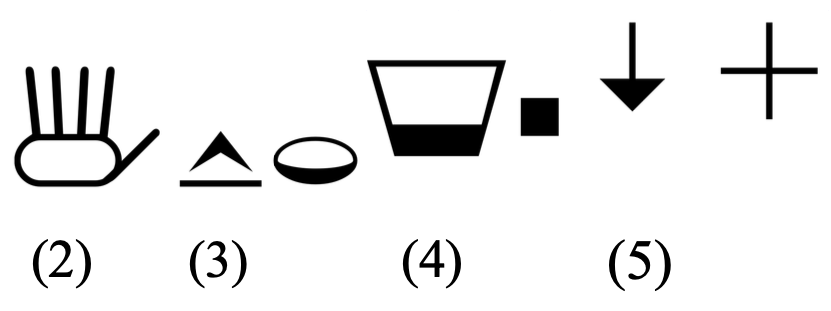
location, the first graph of < > signifies that the dominant hand is located at the abdominal level and the second graph signifies that it is ipsilateral from the signer’s perspective. For (5) movement, the first grapheme of < > signifies that the dominant hand moves downward for normal distance (additional symbols are used for small or large movement), and the subsequent grapheme signifies that the movement is repeated once. Since many graphs are required to be written down in order to describe surface forms on a phonetic level, use of this system is time-consuming and researcher-oriented.
§§ Sutton SignWriting
Sutton SignWriting is a writing system with iconic graphems developed by Valerie Sutton. She initially developed Sutton DanceWriting in Denmark to write down ballet choreography of Bournonville style. Graphs are configured in such a way that the positions of the graphs themselves in the writing space encode the spatial information of the sign (Tuveri, 2024), unlike Stokoe’s Notation system or HamNosys. CHILD in ASL can be written as shown in Figure fig:p.
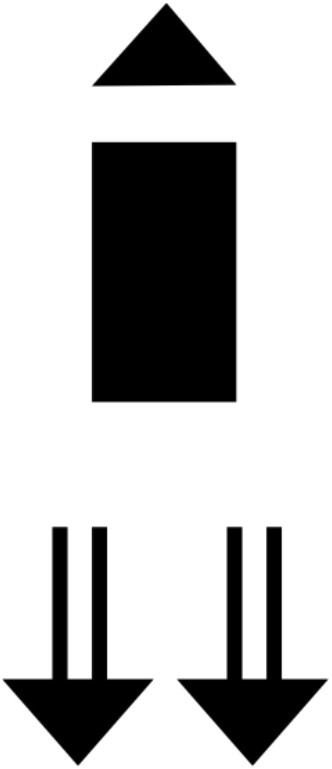
Non-manuals are not written since there are no notable non-manuals. The location of the dominant hand is also not written as, just as in Stokoe’s notation system, neutral space is considered a default location. The grapheme <a> represents two parameters: the handshape and the orientation. The grapheme <b> signifies that the handshape is a flat hand. However, <b> alone signifies that the palm is facing the signer and the axis is upward. It is the black fill of the symbol which signifies that the back of the hand is visible to the signer. In order to indicate that the palm is facing downward, the triangle and the square are separated by a space. The grapheme <c> signifies that the movement is downward. More specifically, the two lines signify that the movement occurs in the vertical axis as opposed to the sagittal axis, which is indicated with one line, <d>.
Due to its extensive spatial use, it is virtually impossible to implement SignWriting in Unicode.
§§ Problems of existing writing system
Four major problems have been identified by analyzing the three existing writing systems although this is not to say that all of these problems are observed to the same extent in all of the writing systems listed above. The ideal writing system, however, should solve or at least should be faced with some of these to a lesser extent.
The first problem is that writing graphemes is time-consuming and utilizes too much space per sign. This seems to be the most significant problem that these systems share. This problem is caused by several factors: use of spatial information on a writing material; detailed phonetic information; repeated information for two-handed signs. SignWriting uses spatial information on writing material to convey spatial relation of articulators. Although it is undeniable that use of spatial information helps readers to visualize signs with ease, use of this kind of writing system is time-consuming. Detailed phonetic information is certainly useful for researchers, especially to annotate corpus data. However, it is not suited for everyday use. Additionally, repeated information for two handed signs, at least type 1 and type 2, is not necessary and can easily be substituted with a grapheme that indicates symmetricity of the handshapes.
The second problem is the design that is not suited for the Unicode standard. This is caused by the use of spatial information. If by design it is impossible to implement it in Unicode, it is impossible to implement the writing system into the society as discussed in § 2.3.
The third problem is that these systems are almost impossible to handwrite. The use of black fill is rare among various scripts for a reason: it is time-consuming. This problem is also caused by the reliance on iconicity. The use of highly iconic graphemes facilitates the memorization process of graphemes at the expense of significant problems: it is time-consuming and difficult to handwrite with accuracy. For example, in SignWriting, the whole face must be drawn in order to write NMs.
The fourth problem is interlinguistic inapplicability. This, however, is caused by not using iconic graphemes. By the extensive use of Latin script, handwriting signs is less time-consuming and less spacious on the writing material. A writing system of sign languages relying on the Latin script automatically implies that the graphemes in the Latin script correspond to handshapes configured for fingerspelling. However, the problem of this is that fingerspelling conventions are different from country to country, causing interlinguistic inapplicability. This entails that the ideal writing system needs graphemes that are not based on the Latin script but iconic to a lesser extent such that they are easy to write but still allow the user to see the relation between the graphemes and the shape of the articulators.
Werberry - a new sign language writing system
In this chapter, features of the proposed writing system will first be introduced. Thereafter, its structure, how the different parts interact with one another, and what each grapheme signifies will be discussed.
§ Anatomy of Werberry
In this subsection, how the three main parameters, namely hand shape, location and movement, are configured will be discussed. Thereafter, in §§3.2.1-3.2.3, how each part functions will be discussed.
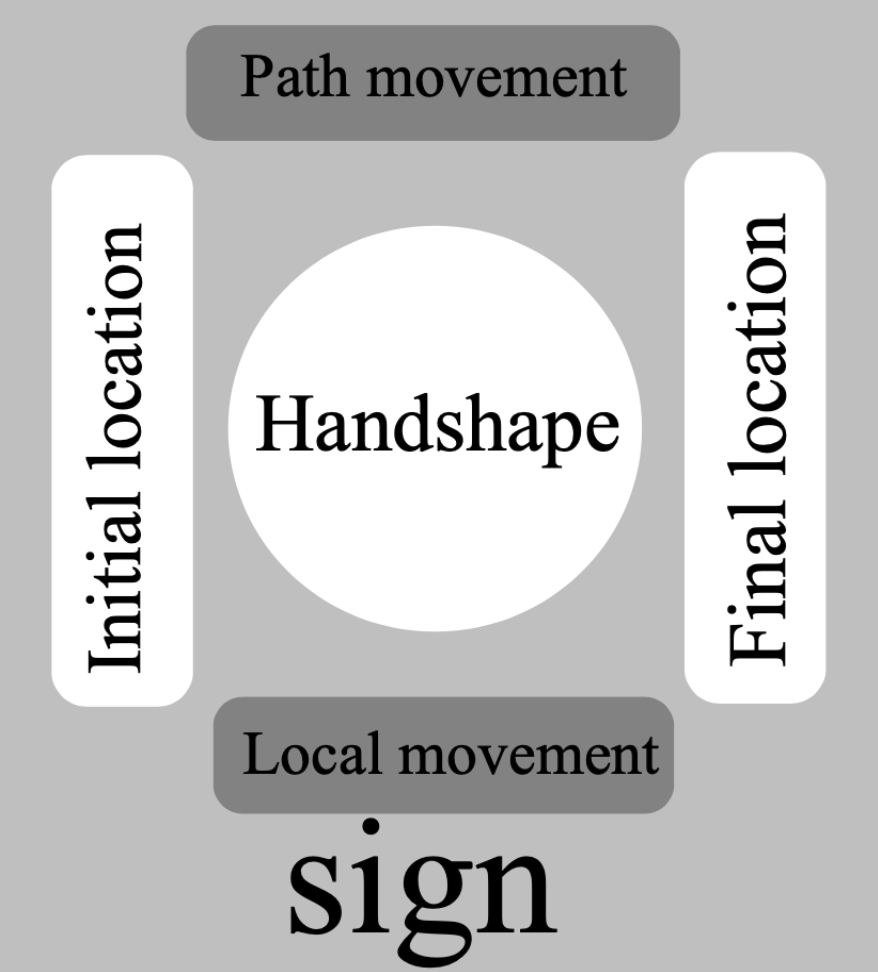
All the three parameters (handshape, locations, and movements) are configured as one unit as shown in Figure fig:q. A unit in Werberry consists of three main components: core, vertical, and horizontal. The core grapheme in the center signifies the handshape. Note that handshape graphemes never indicate the orientation and that the orientation does not have any own separate grapheme in the unit. Vertical graphemes signify the location. If the sign involves only a local movement, the left grapheme signifies the location. If the sign involves a path movement, the vertical grapheme on the left signifies the initial location and the other vertical grapheme on the right signifies the final location of the sign. The horizontal graphemes signify the movements. If a sign involves a path movement the feature (e.g. [zigzag] ) is written as a horizontal grapheme on the top. If a sign involves a local movement, it is written below the handshape grapheme (e.g. aperture change).
§ Features of Werberry
Let us start with an example. In Figure fig:child.wb, we use the same example as in §§ 2.5.1-2.5.3, i.e., CHILD in ASL, in order to illustrate general properties of Werberry. The sign requires two graphemes. The grapheme
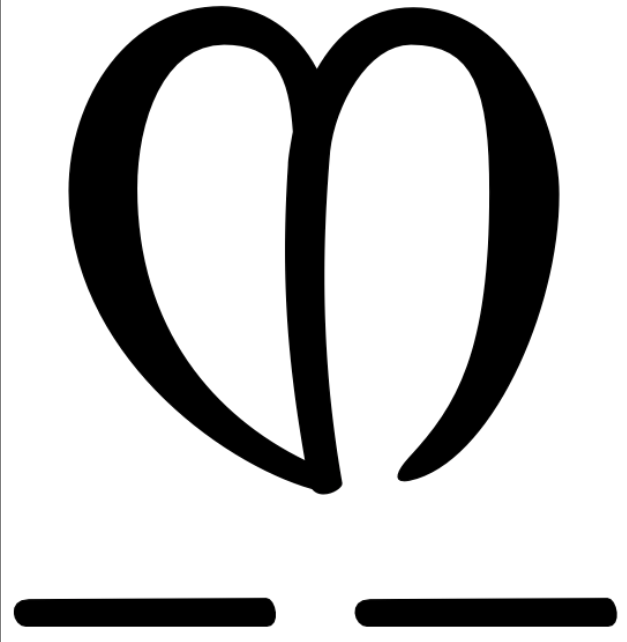
in the center signifies that the hand shape is a flat hand. The grapheme below the handshape grapheme signifies that the movement is a slight tap in the air [Note: This movement can be interpreted as a short path movement. However, it is treated as a local movement in Werberry as it is likely to be more intuitive for native signers.] and the use of two lines signifies that the movement is repeated. Werberry is classified as an alphabetic syllabary just as Hangul. In an alphabetic syllabary, graphemes that represent one syllable are configured in one unit as discussed in §2.2.3, which is also the case for Werberry. Units in Werberry are designed to consist of the smallest number of graphemes possible in one unit to be reconstructed and of graphs that can easily be handwritten. In order to have a minimal number of graphemes in a unit, certain information is omitted and expected to be reconstructed by readers. Such information is as follows: unmarked phonemes, orientation, and NMs. The most unmarked phonemes are treated as default value. The default values are a slight tap in the air for the local movement, the straight movement for the path movement, and the neutral space for the major location. This, however, does not entail that default values are applied all the time when reading in Werberry. For example, if the final location is not transcribed in the unit, it does not signify that the sign has a straight path movement but rather that the sign does not involve any path movement. Therefore, the default value for the path movement is not applied in this case. This is exemplified by the sign CHILD in ASL. Throughout the course of the sign, the location remains constant. Moreover, there is no grapheme for the initial location either, entailing that the default value of the location is applied and the sign is articulated in the neutral space throughout the course of the entire sign. Although in principle any orientation is possible (e.g. palm up, palm down) with a flat handshape and repeated slight tapping in the air and the default value of location ([neutral space] ), the only plausible lexical word in ASL is CHILD. As the orientation is a subordinate category to the major category of hand configuration (Sandler, 1989; 2012), it has less phonological importance. Therefore, it is never written in Werberry. With all the information provided from graphemes in the unit, the orientation of the sign is usually predictable even without context. That is, with the phonemes written in the unit, there is only one plausible orientation. Moreover, even if two distinct signs that only differ in orientation merge in Werberry, the sentence context will usually provide sufficient aid to determine the sign just as in the abjad system discussed in §2.2.2.
§§ Handshape
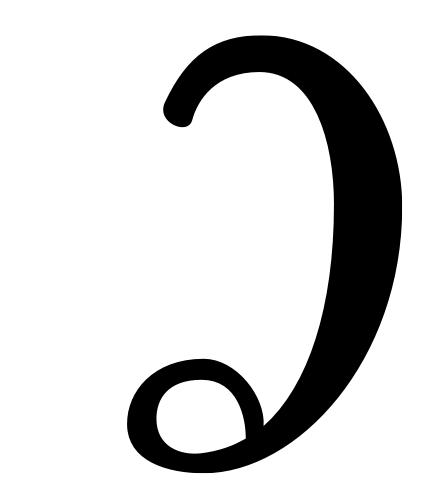
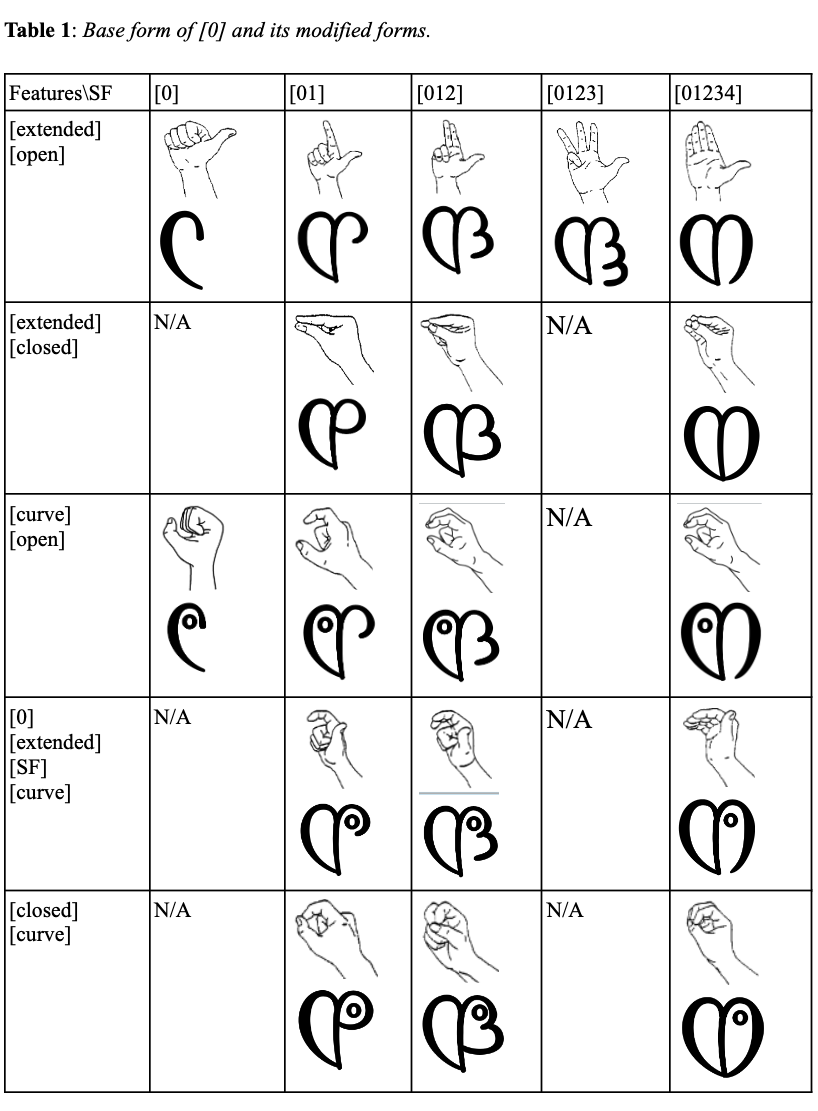
Let us start with two base forms of handshape graphemes. The grapheme shown in Figure fig:b0 signifies that the selected finger is only the thumb and simply extended. The grapheme shown in Figure fig:b1234 provides similar information except for the selected finger, which is all the four fingers.
![[0]](/blog/thesis-figures/b0.png)
![[1234]](/blog/thesis-figures/b1234.png)
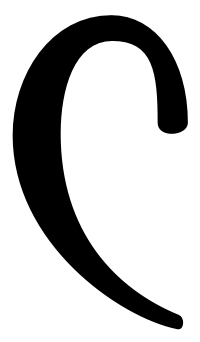
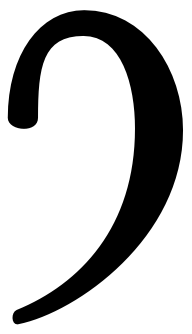
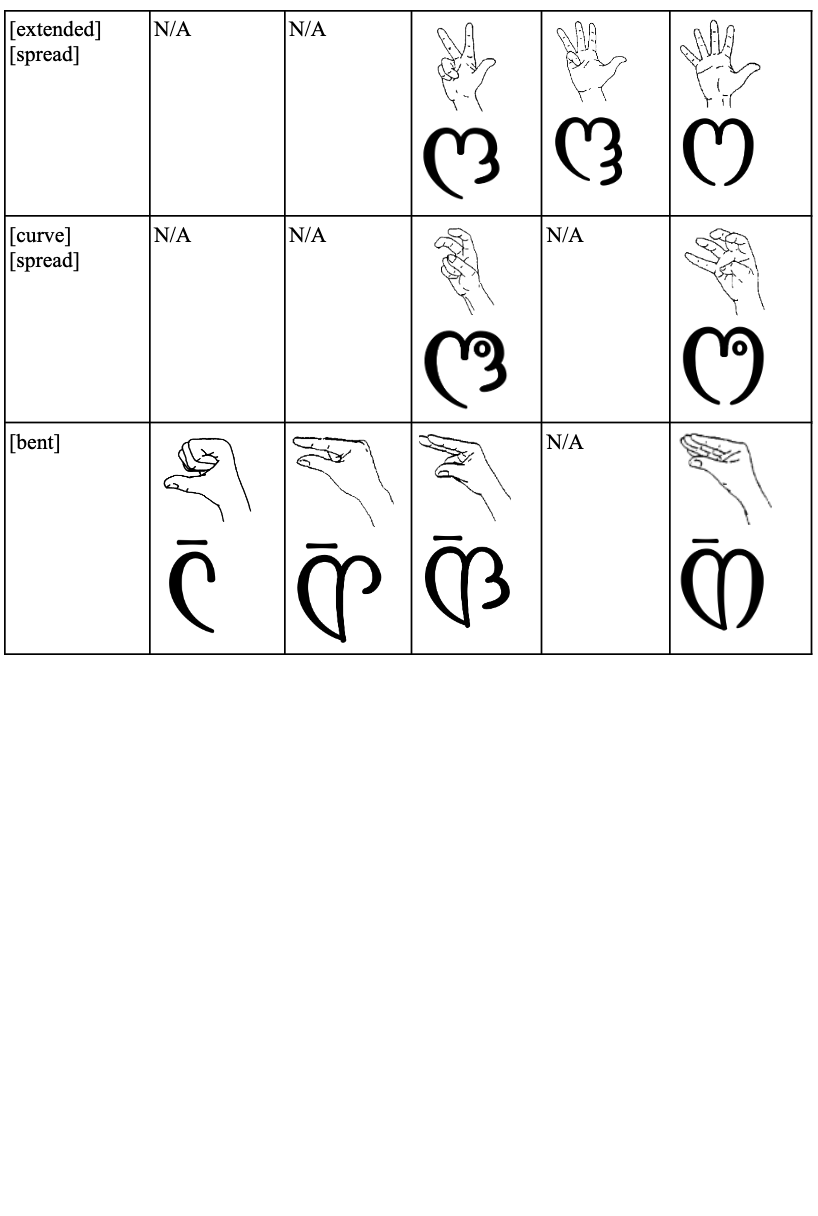
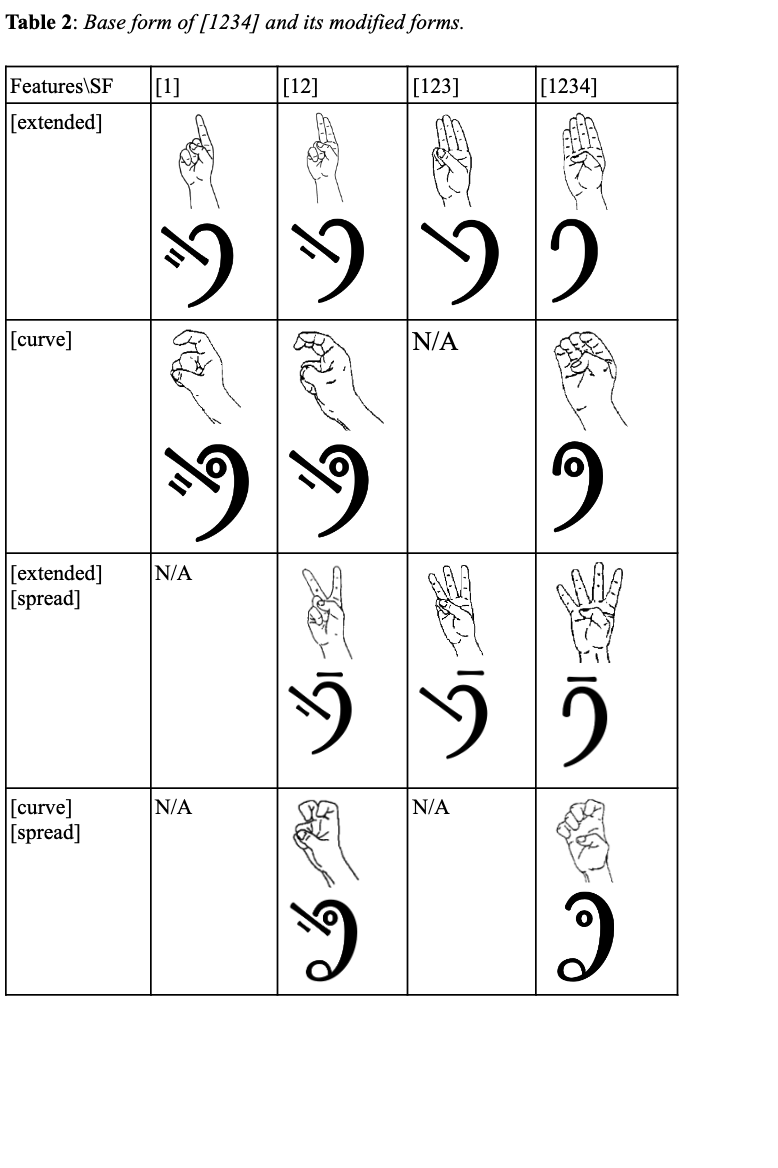
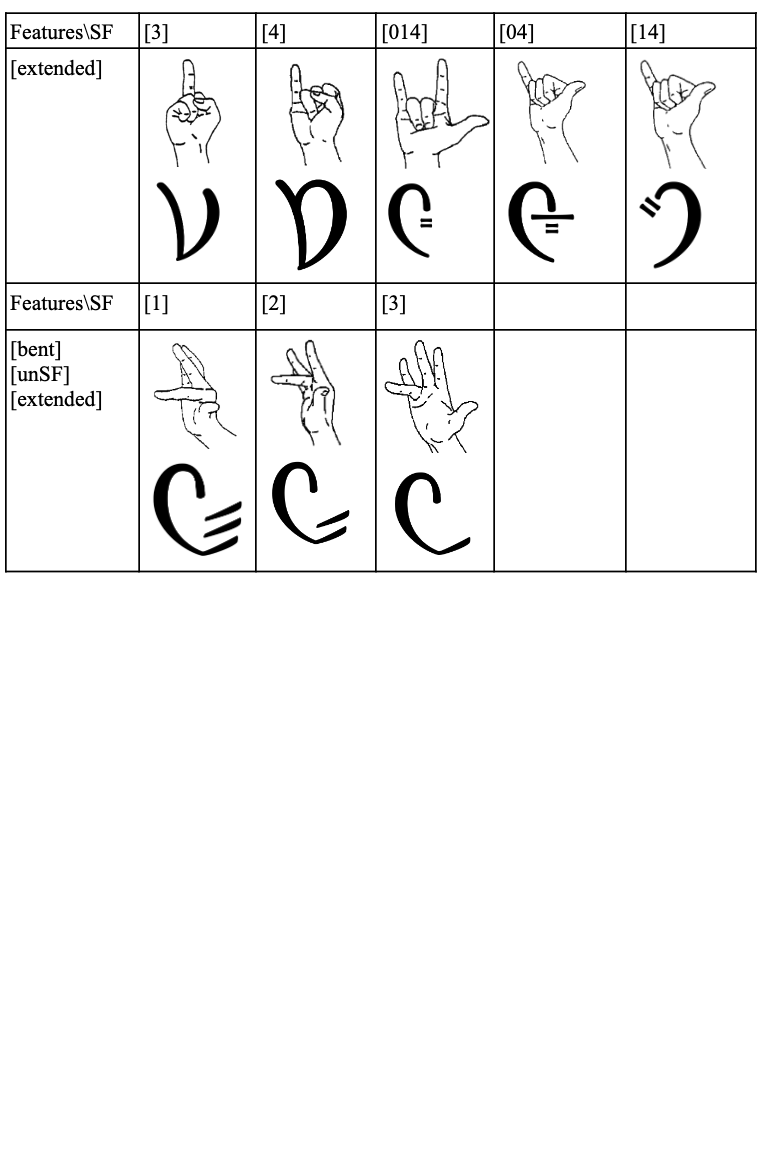
Henceforth, selected fingers are referred to with numbers (thumb, index, middle, ring, and pinky are [0], [1], [2], [3], and [4] respectively). It is possible to modify these base graphemes to signify the different selected fingers in a systematic manner. By adding a vertical line in the center and the arc on the top right, it now signifies [01] as shown in Figure fig:b01.wb. The number of arcs corresponds to the number of selected fingers. With [01234], the arc becomes large enough to reach the bottom of the vertical line and meets the bottom edge. For the base form of [1234], selected fingers can be modified by adding the straight diagonal line on the left to the arc. With one long line added, it signifies [123] shown in Figure fig:b123.wb, with two lines, [12] shown in Figure fig:b12.wb, with three lines, [1] shown in Figure fig:b1.wb.
![[123]](/blog/thesis-figures/b123.png)
![[12]](/blog/thesis-figures/b12.png)
![[1]](/blog/thesis-figures/b1.png)
![[01]](/blog/thesis-figures/b123-wb.png)
![[012]](/blog/thesis-figures/b12-wb.png)
![[0123]](/blog/thesis-figures/b1-wb.png)
![[01234]](/blog/thesis-figures/b01.png)

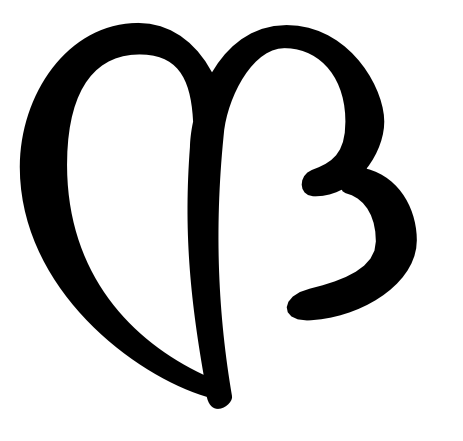
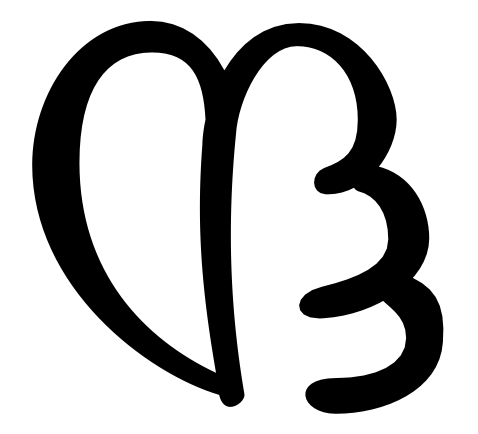
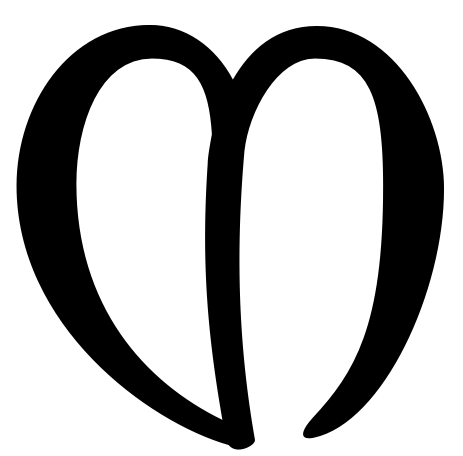
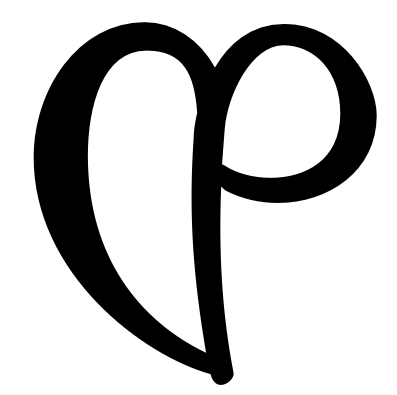
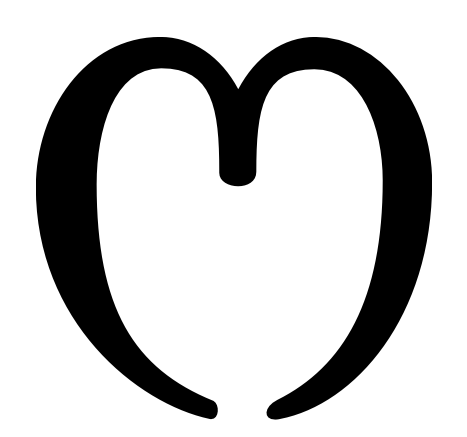
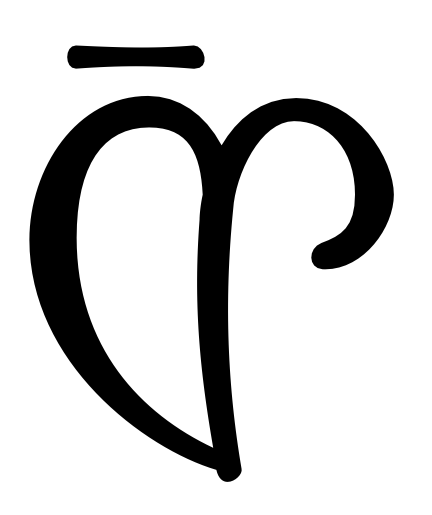
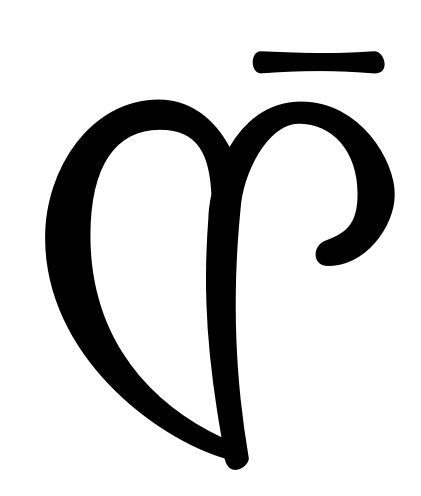
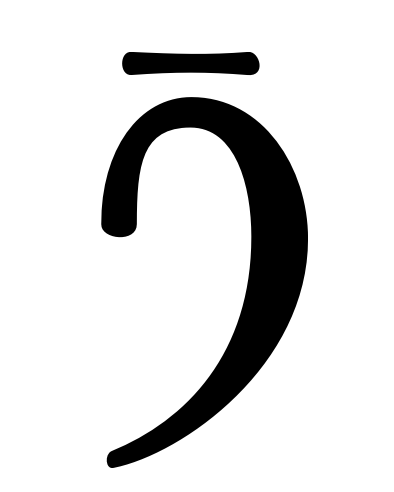
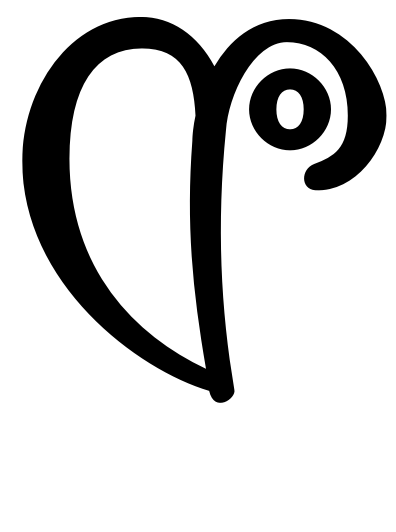
[curve] can be specified with a circle inside the arc and this is applicable to both of the base graphemes shown in Figure fig:bcv0.wb and fig:bcv1234.wb. Note that the position of the circle can be either left (as shown in Figure fig:bcv01.wb) or right (as shown in Figure fig:b0cv1.wb) for the base grapheme of [0]. The difference is that with the circle on the left signifies that [0] is also curved whereas with the circle on the right signifies that [0] is not. This convention is not applicable to the base form [1234] because by design, it never contains [0]. In order to specify [aperture], the end of stroke changes position. If the end of the stroke is not connected to a line as shown in Figure fig:b01.wb, it signifies [open] and otherwise, it is [closed] as shown in Figure fig:bcl01.wb. [spread] can be signified with the same grapheme of [01234] without the center line shown in Figure fig:bsp01234.wb. For [1234], it is indicated with a circle connected at the end of the stroke as shown in 21n. In order to specify [bent], a line is added on the top of the arc. Just as [curve] for the base form of [0], if the line is on the left side of the arc, [bent] is applied to both the thumb and the selected fingers as shwon in Figures fig:bb01.wb. If the line is on the right side of the arc, [bent] is applied only to the selected fingers as shown in Figure fig:b0b1.wb. For the base form of [1234], the line can only go on the top of the right arc shown in Figure fig:bb1234.wb, since thumb cannot be selected by design.
Since these features are independent, graphemes can also be combined. For example, in an "O" handshape, [closed] and [curve] are applied, which is signified by the circle in the right half and the stroke connected at the bottom end as shown in 21o. Graphemes for handshapes of the non-dominant hand will be discussed in 3.2.4.
![[0]](/blog/thesis-figures/bcv0.png)
![[1234]](/blog/thesis-figures/bcv1234.png)
![[01]](/blog/thesis-figures/bcv01.png)
![[01]](/blog/thesis-figures/b0cv1.png)
![[01]](/blog/thesis-figures/comp1.png)
![[01234]](/blog/thesis-figures/comp2.png)
![[1234]](/blog/thesis-figures/comp3.png)
![[1234]](/blog/thesis-figures/comp4.png)
![[1234]](/blog/thesis-figures/bcl01.png)
![[1234]](/blog/thesis-figures/bsp01234.png)
![[01234]](/blog/thesis-figures/bsp1234.png)

§§ Location
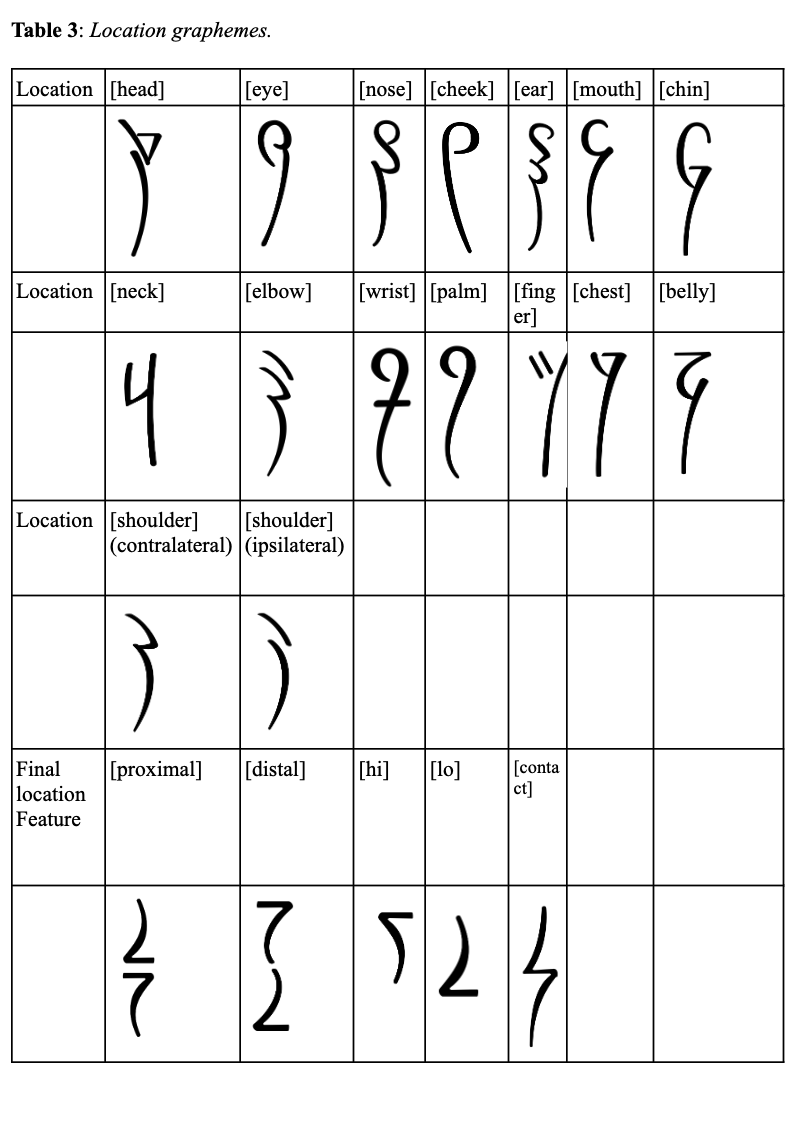
If a sign does not involve any path movement, one grapheme will be transcribed on the left. If a sign involves a path movement, two graphemes will be transcribed on the both sides, left and right. However, this does not entail that the number of graphemes correspond to the number of graphs because if a sign consists of phonemes that are considered as default values, the corresponding graphemes do not have visible graphs. For example, the sign CHILD in ASL, does not have any graph on the left side. This is because the grapheme for [neutral space] does not have any visual graph. This entails that for a sign without any path movement, the unit contains either no visible graph or one graph for one grapheme. This is what we established in the last section.
However, for a sign with path movement, a graph for the final location is always transcribed as it cannot be deduced, while the grapheme for the initial location may have no visible graph. For example, the sign GIVE in ASL shown in Figure fig:give.fig is articulated within the major location, [neutral space], and the setting [proximal] to [distal]. As [neutral space] is the default value, no graph is in the initial location. In the final location, there is only a graph for distal because in order to be contrastive the initial location has to be proximal. Therefore, [proximal] also does not have any visible grapheme. The setting feature is not always used. For example, in the ASL sign, PARENTS, the path movement proceeds from [forehead] to [chin] and this is usually analyzed as [high] to [low] in [head] with [arc] in Sandler's framework. However, this is unlikely to be intuitive for native signers. Therefore, in Werberry, it is simply written as [forehead] to [chin] with [arc].
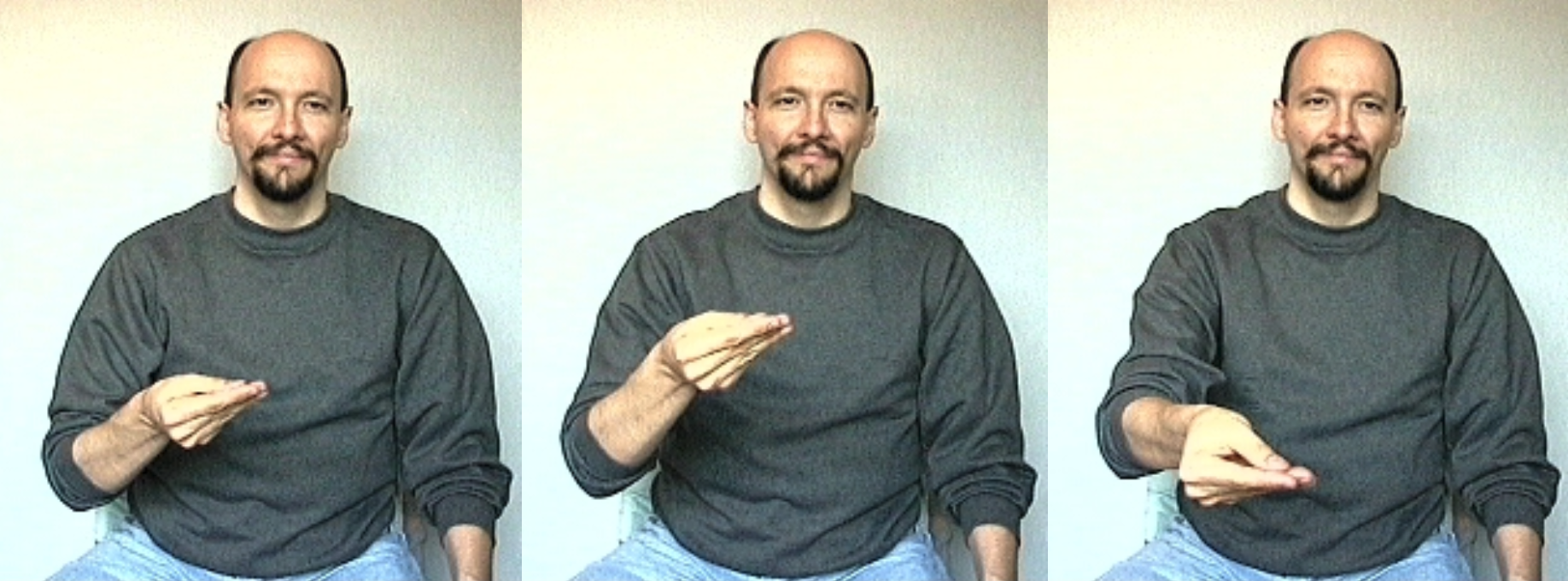
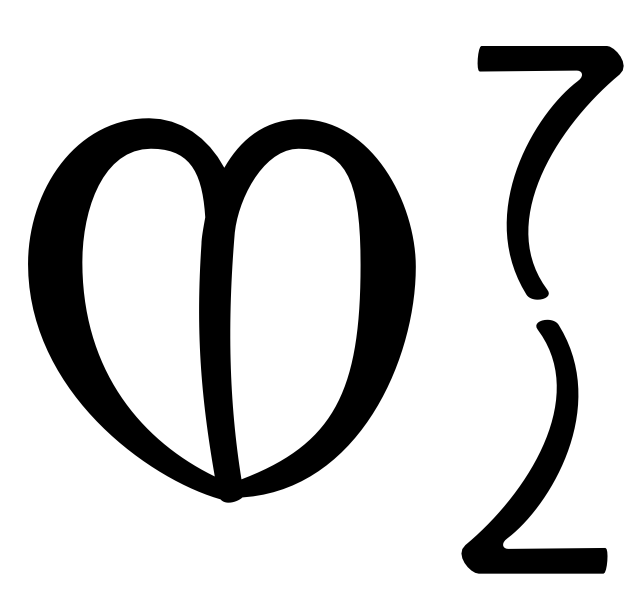
§§ Movement
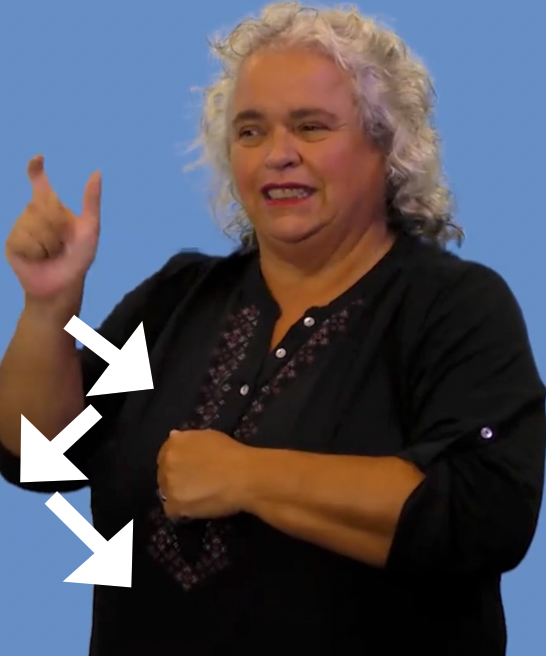
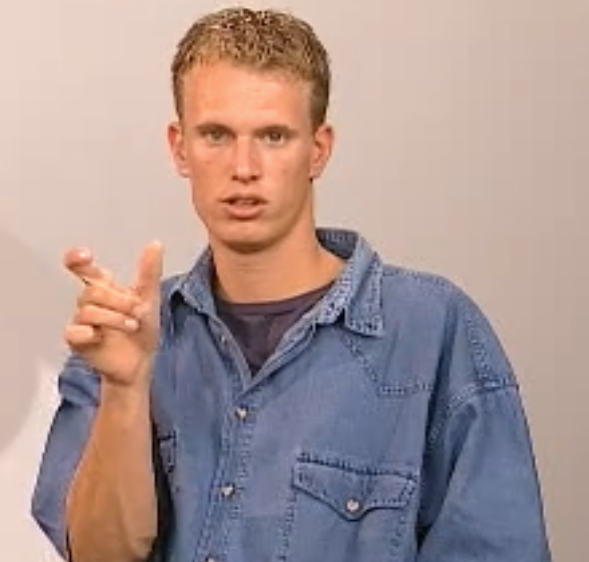
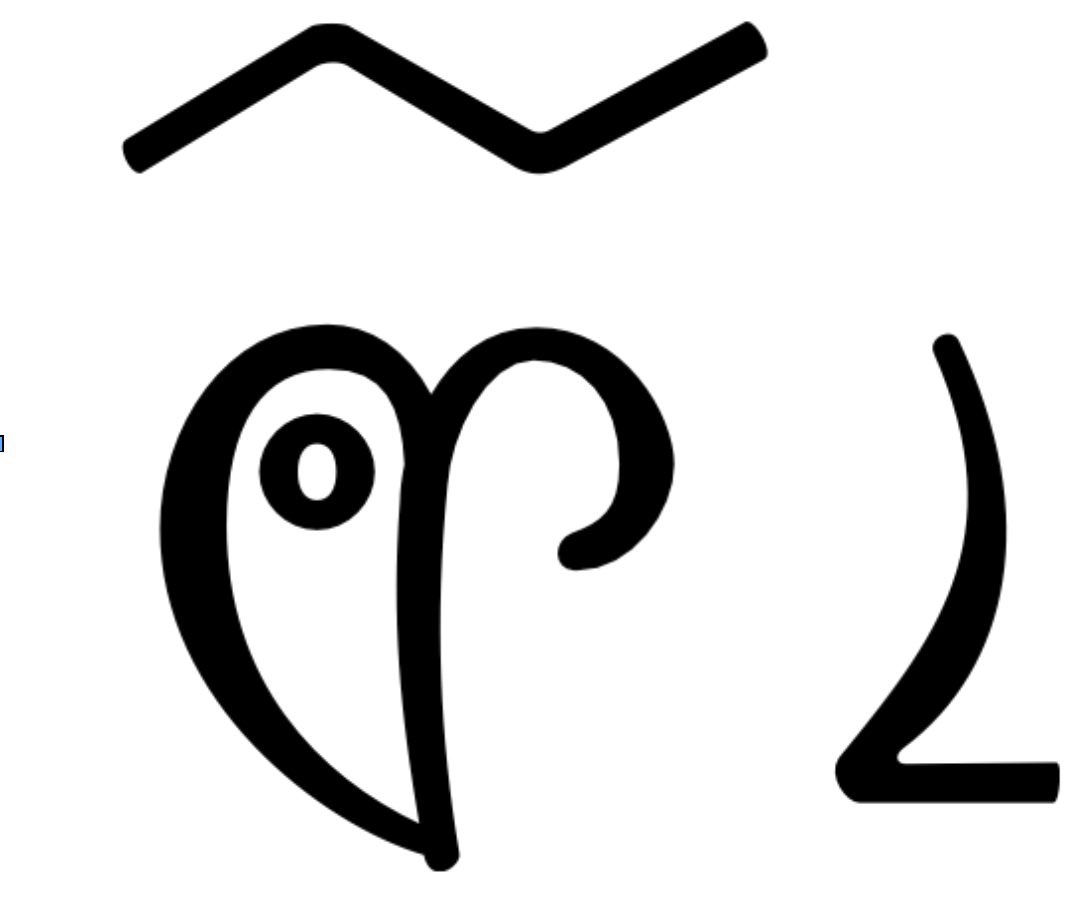
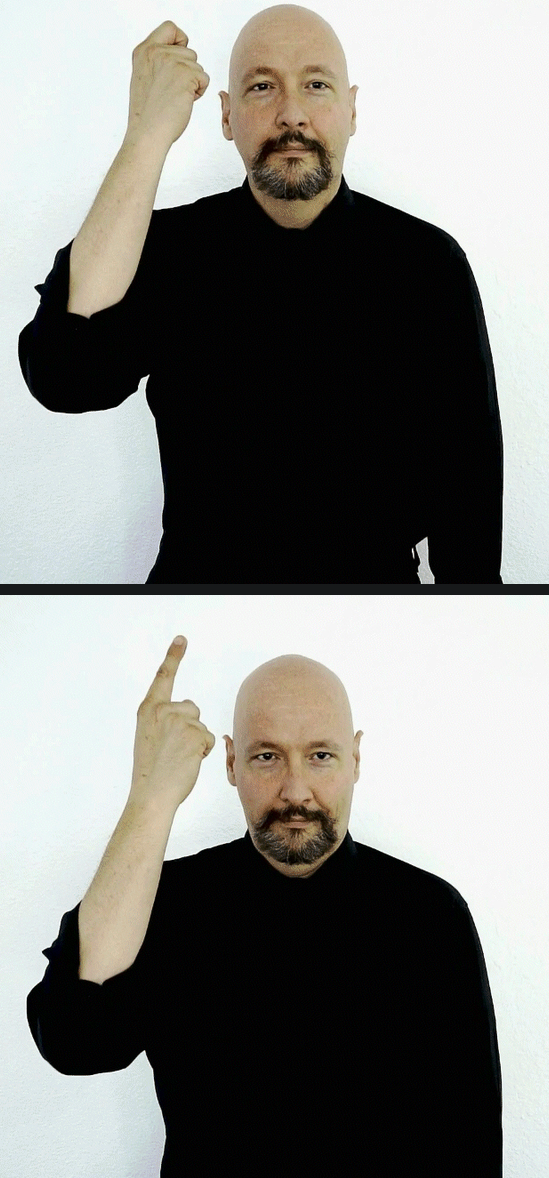
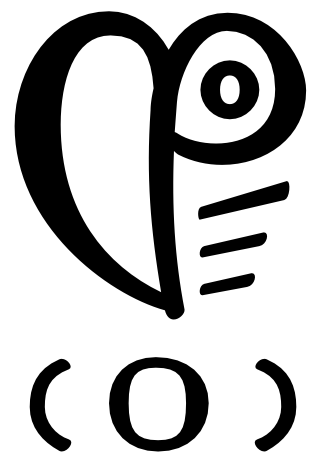
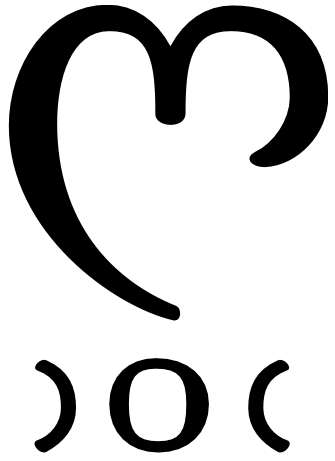
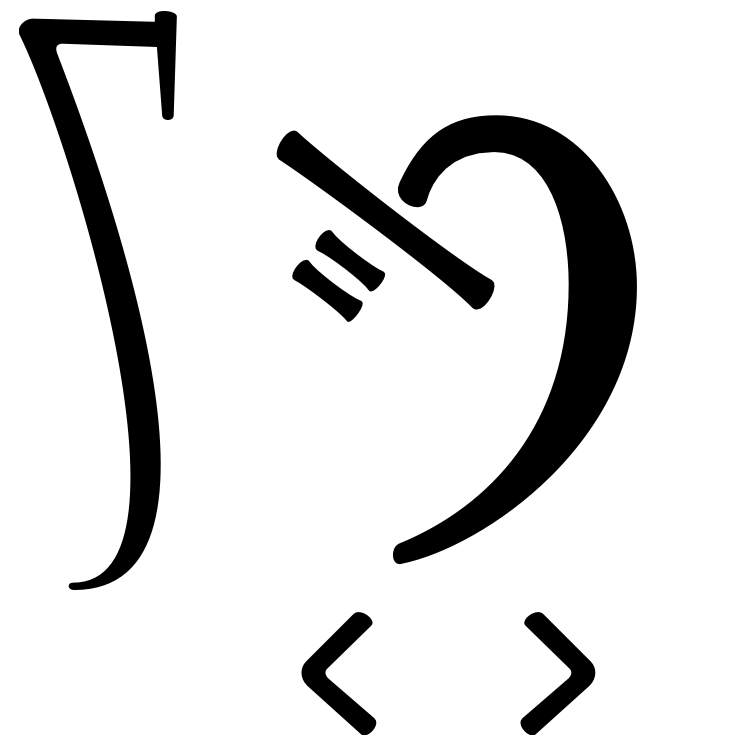
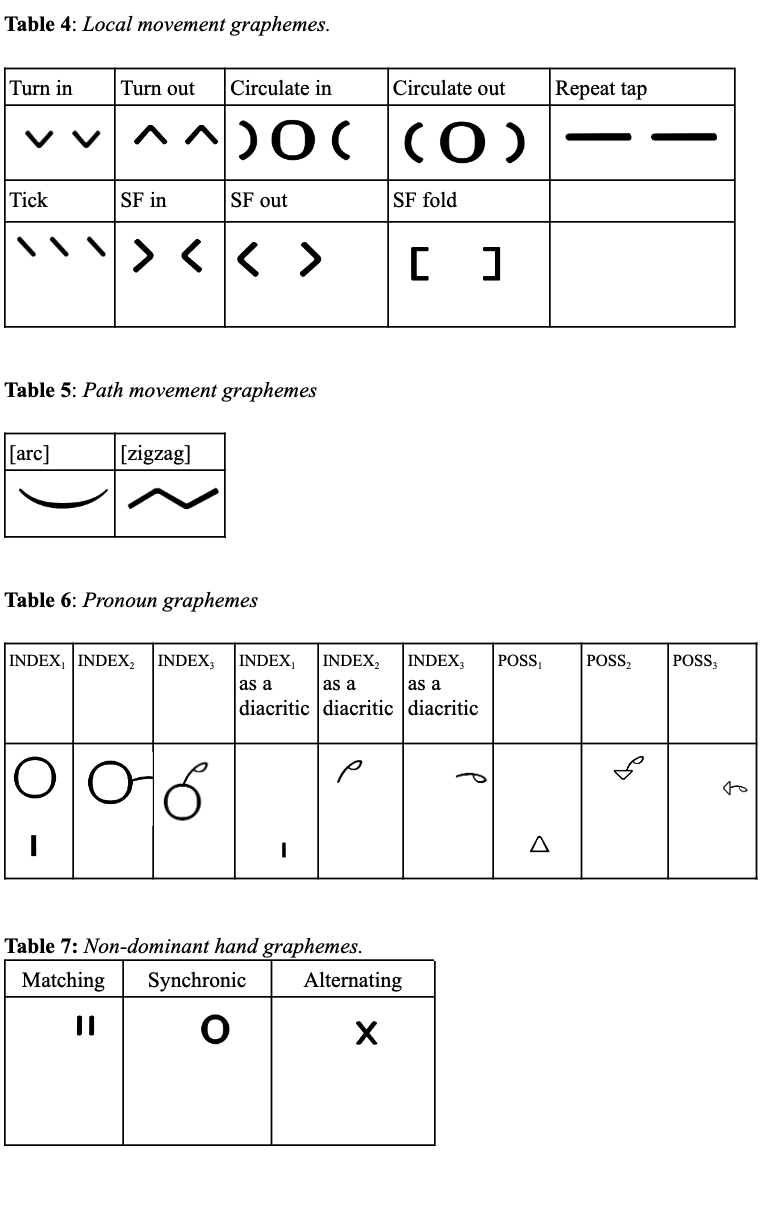
Just as briefly mentioned above, path movements can be written on the top of the handshape grapheme. The sign for ITALY in NGT shown in Figure 23a illustrates how another feature [zigzag] can be written. By adding the zigzag lines as shown below, the path movement is defined as [zigzag]
Local movements are written below the handshape grapheme. If a sign involves virtually no movements or a slight tapping movement in the air, there is no visible graph for the path movement grapheme (if repeated, the grapheme will have graph as shown in Figure fig:child.wb) as it is the most unmarked movement and consequently default value. This is illustrated by the NGT sign WORD shown in Figure fig:word.wb. Since it involves a slight tap in the air, the only required graph is the handshape grapheme.
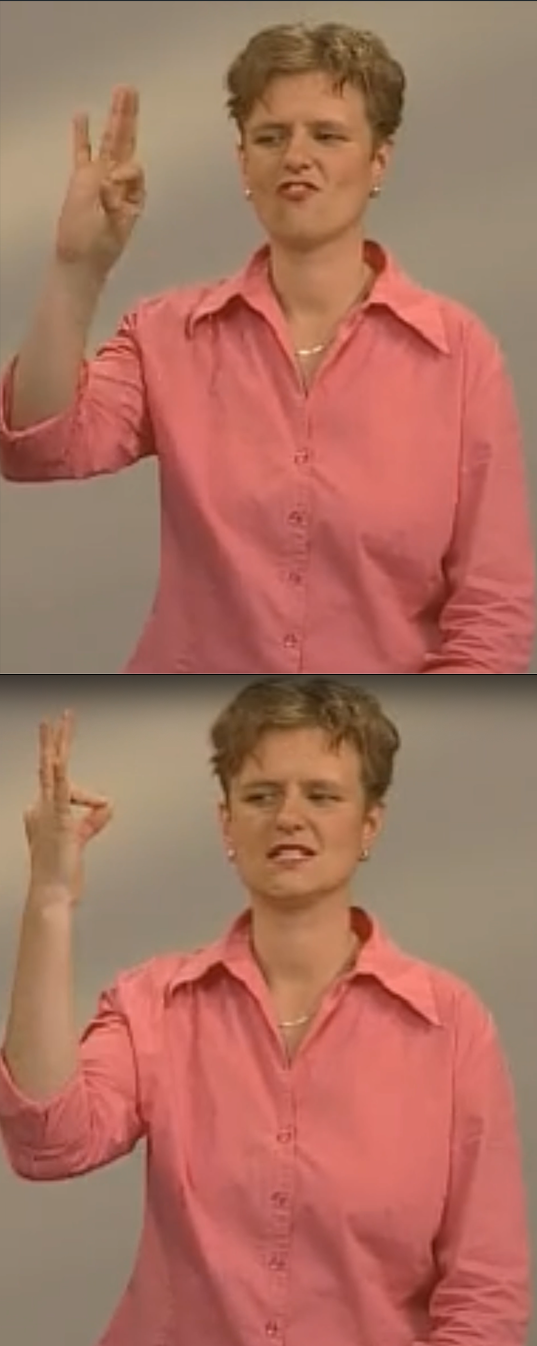
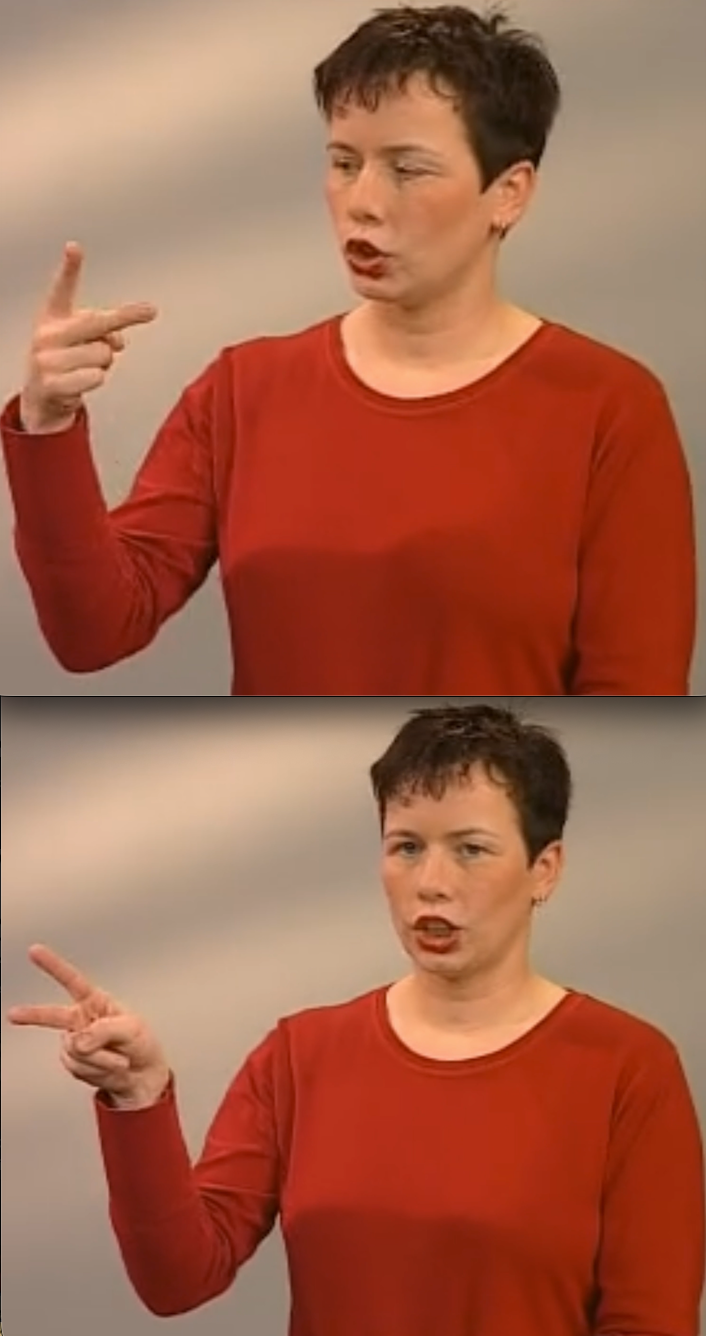
If a sign involves a marked local movement, orientation change for example, it can be written with a circle and arcs. With arcs facing inward, it signifies that the orientation turns inward, which is illustrated by the NGT sign, FRANCE shown in Figure fig:france.wb. The outward orientation change is illustrated by the NGT sign, TWENTY shown in Figure fig:twenty.wb.
Moreover, local movement graphemes are transcribed for signs with internal movement. For example, the ASL sign UNDERSTAND shown in Figure fig:understand.wb can be written with the internal movement grapheme below the handshape grapheme. Note that the handshape grapheme signifies [1] with [extended] instead of a fist because the handshape before the internal change does not provide sufficient information to determine the selected finger. Since this internal movement grapheme signifies that the selected finger gets extended, the handshape before the change can be easily deduced to be a fist. Internal movement and orientation change can be combined, and in Werberry, this combination can be written as a polygraphemic multigraph just as <sch> in German. For example, the NGT sign INTERNET can be written with a multigraph that signifies [open] from [closed] and orientation changes by turning inward.
§§ Two-handed signs
For type 3 (asymmetrical two-handed) signs, the non-dominant hand will not be transcribed with any grapheme because it can be easily deduced due to the dominance condition: the non-dominant hand can only have a limited number of unmarked handshapes. Even if signs with different unmarked handshapes merge in Werberry, the context is likely to provide enough information to determine the intended sign. Although one-handed signs and asymmetrical two-handed signs may seem to merge in Werberry, it does not since having a hand grapheme for the location entails that it is the asymmetrical two-handed sign. The two NGT signs, POLITICS and ALBERT-HEIJN illustrate this distinction. ALBERT-HEIJN shown in Figure fig:appie.wb is articulated on the forehead with a ticking movement. However, POLITICS shown in Figure fig:politics.wb is articulated on the non-dominant hand, which cannot be articulated as a one-handed sign.
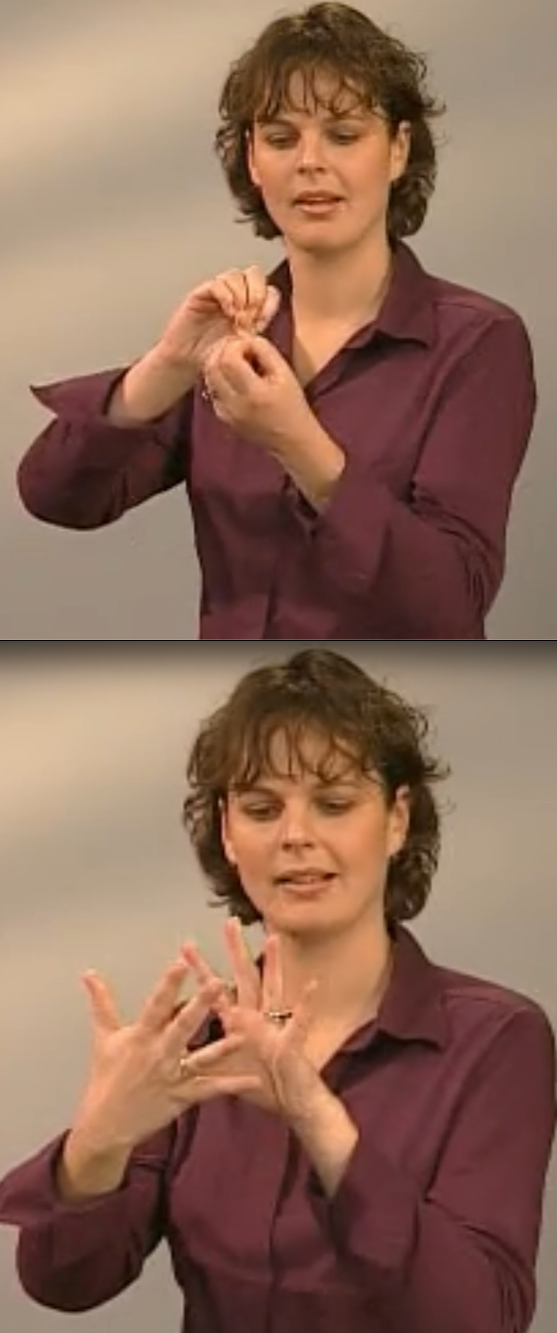
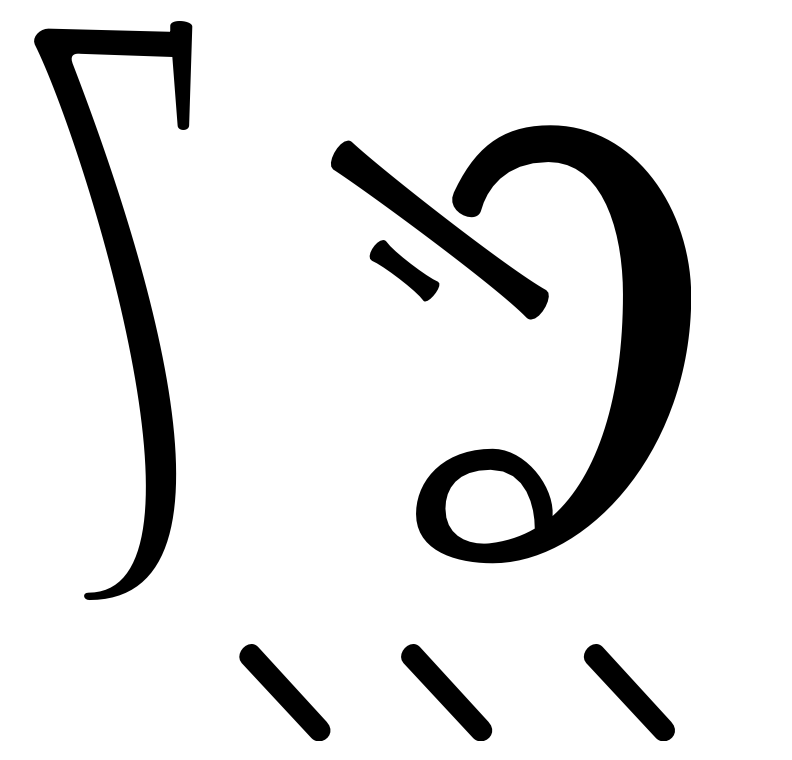
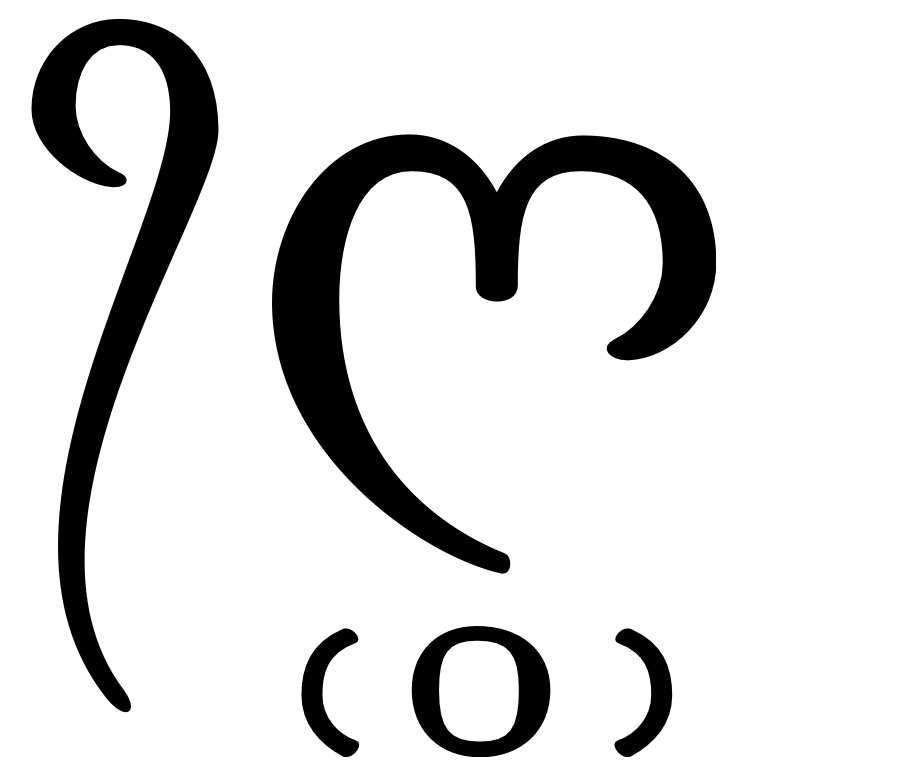
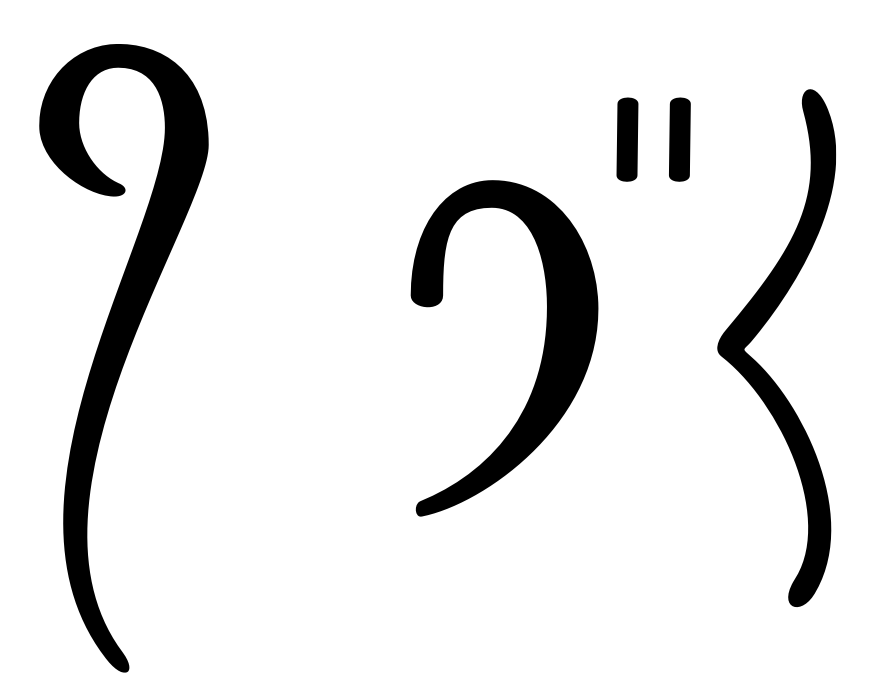
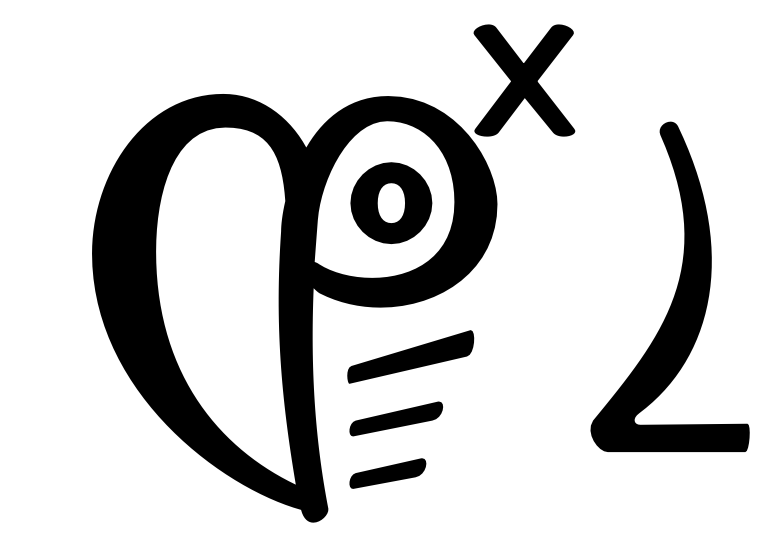
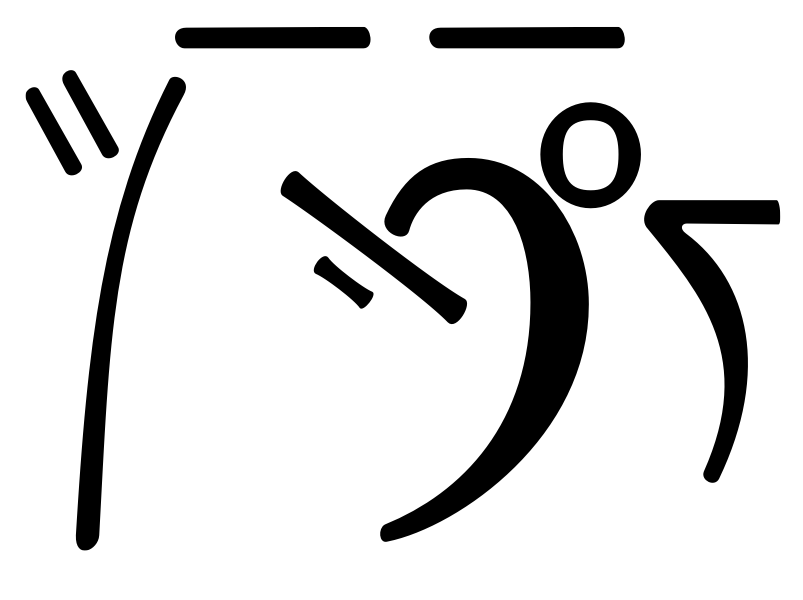
For symmetrical signs (type 1 and 2), the movement is specified with one of the three graphemes: synchronic, alternating, or no movement (henceforth referred to as "matching" grapheme to avoid confusion that it is default value). For SAME, two short lines (synchronic grapheme) are transcribed on the top right of the handshape grapheme as shown in Figure 24d. For JUDGE shown in Figure fig:judge.wb, the alternating grapheme, <x>, is transcribed in the same position as the synchoric grapheme. For GREEN shown in Figure fig:green.wb, the matching grapheme, <o>, is transcribed in the same manner to indicate that the handshapes are identical ("matching") but the non-dominant hand does not involve any movement.
§§ Pronouns
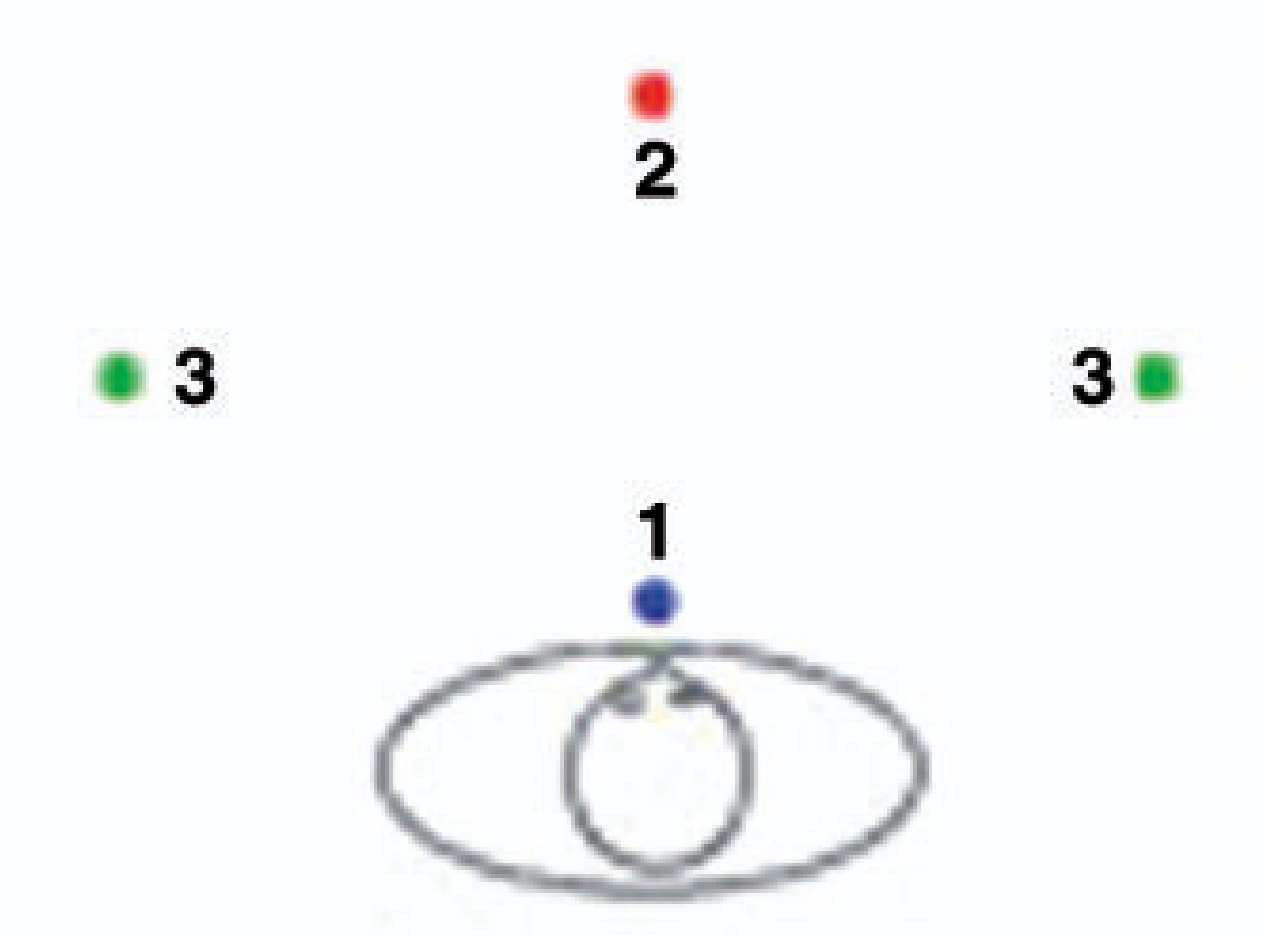
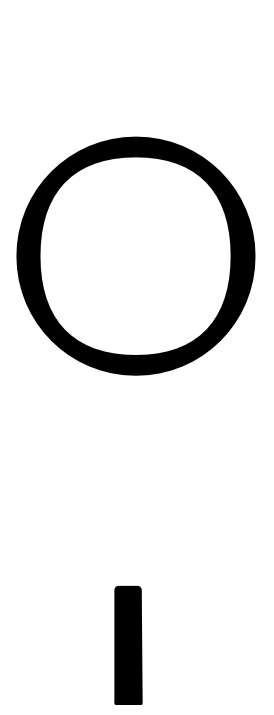
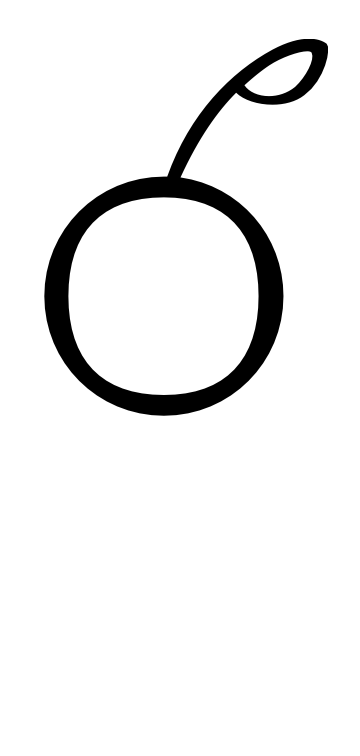
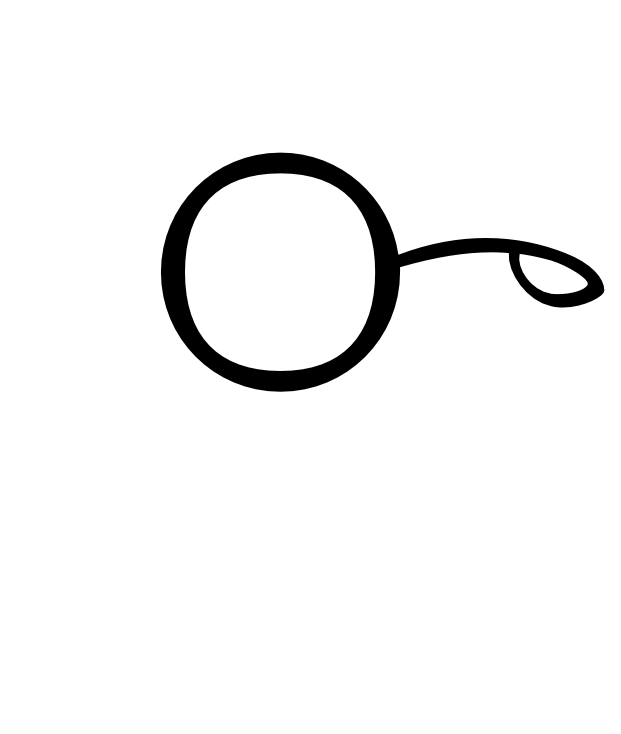
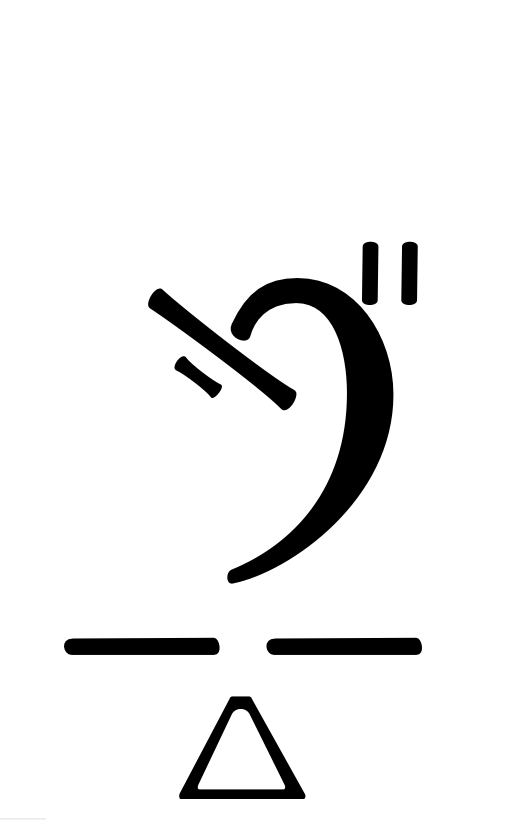
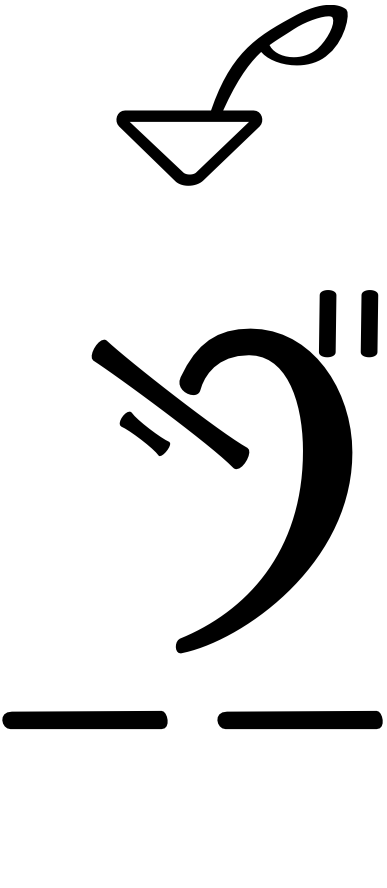
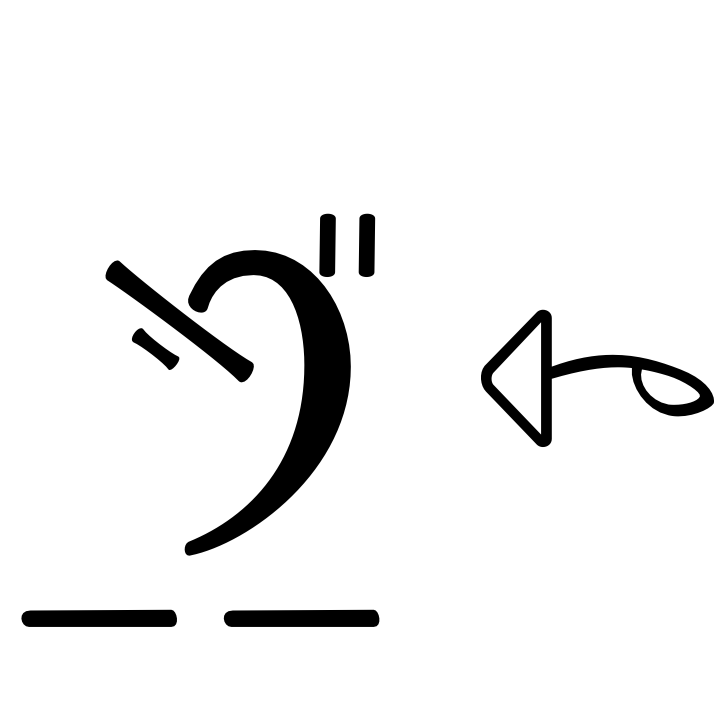
Graphemes for pronouns in Werberry are transcribed as logographs. This is because the main phonologically contrastive feature of personal pronouns is orientation of the fingertip, and it cannot be written in Werberry. While it is true that first person and second person can be differentiated with [distal] and [proximal] in [neutral space] ([proximal] for the first person and [distal] for the second person), it is important for the grapheme to feature visually distinct shapes to avoid confusion of the two signs. Even with this framework, it is impossible to make a distinction between the sencond person and the third person since they are both [distal]. Logographs can solve this issue as they are tied to semantic information rather than phonological information. In order to write in the first person, a short line is drawn below the circle as shown in Figure fig:ind1. For the second and third person, a leaf is drawn as shown in Figures fig:ind2 and fig:ind3. The leaf for the second person is written at the opposite side from the first person as this is a top-down perspective as shown in Figure fig:localization. For the same reason, the third person is written on the right (INDEX_3 or INDEX_3a) or the left side (INDEX_3b).
The NGT copula sentences shown in the following example below illustrate how the personal pronoun grapheme can be written in sentences.
Example:. 1 nederlands INDEX_1 DUTCH "I am Dutch.". 2 nederlands INDEX_2 DUTCH "You are Dutch.". 3 nederlands INDEX_3 DUTCH "She/he is Dutch."
As is evident from the design of the personal pronoun graphemes, they can attach to units of lexical signs just as diacritics by removing the circle, especially for units of signs used for localization as show in the following example, where the diacritic for INDEX3a appears to the right of the lexical sign TEACHER.. 1 neu lehrerhe moegen INDEX_1 NEW TEACHER.INDEX_3a LIKE "I like the new teacher."
Moreover, possessive pronouns can attach in the same manner as localizing pronouns. For the first person, a triangle is used as opposed to a line as shown in Figure fig:lehrer_poss1. For the second and third person, a triangle is added to the stem of the leaf as shown in Figures fig:lehrer_poss2 and fig:lehrer_poss3.
Discussion
By comparing existing writing systems of both spoken and sign languages, advantages and disadvantages that Werberry shows will be analyzed. § 4.2 discusses the feedback that has been collected from the discussion among University students in the linguistic faculty.
§§ Advantages of Werberry
The advantages will be analyzed by comparing a DGS sentence transcribed in HamNoSys and Werberry. Figure fig:sentencedgs illustrates how transcription in HamNoSys can get complex given that all the phonetic information is transcribed. For example, a sentence in DGS can be written as shown in Figure fig:sentencedgs below.
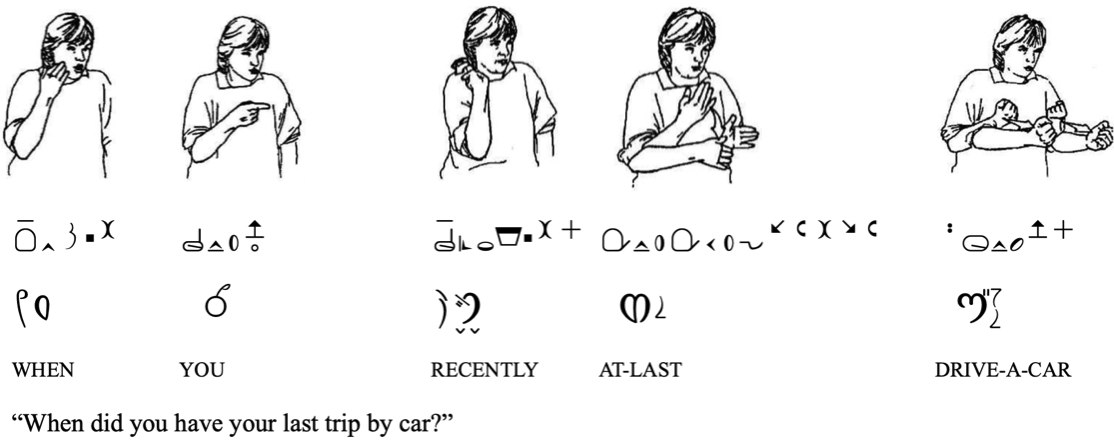
The grapheme to sign ratio in Werberry in the sentence is significantly lower than the ratio in HamNoSys: 2.2:1 in Werberry; 6.6:1 in HamNoSys. Although this is subject to interpretation as to which line to count as one stroke, writing the sentence in Werberry requires 21 strokes whereas in HamNosys it requires 63 strokes, which is three times more. Moreover, in HamNoSys, there are eight parts that need to be black filled and these cannot be left without black fill as they would be different graphemes without them.
Space used per sign in Werberry is significantly smaller as the graphemes in a unit are stacked together. As pronouns are also phonetically encoded in HamNoSys, it takes as much space as lexical signs whereas in Werberry, the personal pronoun is written as one logograph with one stroke that can be attached onto the unit. As shown in Figure fig:sentencedgs, the second person pronoun only needs one grapheme whereas in HamNoSys it requires four graphemes. Moreover, the agreement can be expressed by modifying pronoun logographs without changing the overall shapes of the graphs, which is an indispensable feature in order to take a morphological decomposition route rather than a phonological decomposition route. Unlike SignWriting all of the features mentioned above are implementable in Unicode, which is also an indispensable feature to utilize the writing system in the modern world.
§§ Disadvantages of Werberry
Interlinguistic applicability of Werberry is arguable since it is written phonologically rather than phonetically. L2 learner will likely be faced with transfer problems because allophones do not necessarily correspond to the allphones of the same phoneme in the target sign language. For example, English speakers tend to pronounce <sum> as /sum/ in Latin as it is written with <m> even though in Latin, /m/ in the final position is pronounced with an allophone of /m/, a nasal vowel. Since the inventory of allophones for a certain phoneme may vary from language to language, this may happen to sign language learners that use Werberry. For examlpe, [01234] with [bent] is considered to be an allophone of [01234] in NGT. However, a NGT learner of another sign language user might not be able to produce [01234] with [bent] without any explicit instruction since in Werberry, allophones are written the same.
Similarly, language transfer might happen for pronoun diacritics as they are logographs. For example, the Arabic numbers are logographs and they are pronounced differently depending on the language (e.g. 1 can be /aɪ̯ns/, /it͡ɕɨ/, or /wan/) Therefore, learners of Japanese Sign Language for example might sign the first person pronoun by pointing at the signer’s own chest although the correct articulation is pointing at the nose.
§ Feedback
In order to gather feedback on general aspects of Werberry, participants were recruited on a messaging app. Participants were seven linguistic students all from the University of Amsterdam. They were asked to participate in a one and a half hour workshop session on Werberry and to provide feedback on the system after the workshop. In the workshop, graphemes and the functions of all the parts were first presented. Additionally, an explanation on how all the parts are configured to form units was provided. Thereafter, the participants were asked to transcribe signs of their choice. It has been pointed out that graphemes are visually pleasing and that especially handshape graphemes are easy to remember since base forms can be systematically modified to represent different configurations of hands. However, participants had trouble distinguishing some graphemes in Werberry, especially the location graphemes. For example, the graphemes for [eye] and [ear] are similar in shape as shown in Figure fig:ear.wb and fig:nose.wb. It is arguable as to whether having the inventory of visually similar graphemes is a fatal problem since there are countless pairs of graphemes that are not easily distinguished but utilized in existing writing systems. For example, < る > and <ろ> in Hiragana and <ъ> and <ь> in the Cyrillic script are hard to distinguish although they represent distinct phonemes. However, users of these writing systems do not seem to have problems. Moreover, since it is not designed for researchers, it is not suited for the use of corpus.
![[ear] transcribed in Werberry.](/blog/thesis-figures/ear-wb.png)
![[nose] transcribed in Werberry.](/blog/thesis-figures/nose-wb.png)
Conclusion
By using the features that spoken writing systems offer and analyzing fatal problems that existing writing systems for sign languages are faced with, this thesis aims to answer the question: What is an ideal writing system for native signers?. The problems that many sign language writing systems are faced with stem researcher-orientated features. This is useful for researchers but consequently cumbersome for the daily use of native signers. Handwriting graphemes of the writing systems mentioned in section 3 is time-consuming and not realistic. Notation of phonetic information is unnecessary for native signers. One of the solutions may be Werberry as is predominantly alphabetic syllabaria and partially logographic writing system with phonological graphemes that can be handwritten. This is not to conclude that Werberry is the only solution to these problems but rather a proposal to the community of native signers. Further research into the efficacy and usability of Werberry as a writing system for native signers must be conducted as this is not investigated in this thesis and it is not clear how effective or usable it is for native signers.
References
.25in1
Battison, R. (1978). Lexical borrowing in American Sign Language. Linstok Press.
Eccarius, P., & Brentari, D. (2007). Symmetry and dominance: A cross-linguistic study of signs and classifier constructions. Lingua, 117(7), 1169–1201. https:// doi.org/10.1016/j.lingua.2005.04.006
Ellis, N. C., Natsume, M., Stavropoulou, K., Hoxhallari, L., Van Daal, V. H., Polyzoeki, N., Braze-Smith, M., & Petalas, A. K. (2004). The effects of orthographic depth on learning to read alphabetic, syllabic, and logographic scripts. Reading Research Quarterly, 39(4), 438–468. https://doi.org/10.1598/RRQ.39. 4.5
Cormier, K. (2012). Pronouns. In R. Pfau, M. Steinbach, & B. Woll (Eds.), Sign language: An international handbook. (Vol. 37, pp. 227–244). DE GRUYTER. https://doi.org/10.1515/9783110261325.227
Fruchter, J., Stockall, L., & Marantz, A. (2013). MEG masked priming evidence for form-based decomposition of irregular verbs. Frontiers in Human Neuroscience, 7, 798. https://doi.org/10.3389/fnhum.2013.00798
Hanke, T. (2010). HamNoSys 4 handshapes chart (H. Zienert, O. Jeziorski, & A. Han, Illus.). Institute for German Sign Language and Communication of the Deaf, University of Hamburg.
Ju, Y., Sambai, A., & Uno, A. (2022). The influence of orthographic units across Korean children of different ages in Hangul reading. Frontiers in Psychology, 13, Article 902910. https://doi.org/10.3389/fpsyg.2022.902910
Meletis, D. (2019). The grapheme as a universal basic unit of writing. Writing Systems Research, 11(1), 26–49. https://doi.org/10.1080/17586801.2019.1697412
Meletis, D. (2020). Types of allography. Open Linguistics, 6(1), 249–266. https:// doi.org/10.1515/opli-2020-0014
Miller, C. (2001). Some reflections on the need for a common sign notation. Sign Language & Linguistics, 4(1–2), 11–28.
Rogers, H. (2005). Writing systems: A linguistic approach. Blackwell Publishing.
Sandler, W. (1989). Phonological representation of the sign: Linearity and nonlinearity in American Sign Language. Foris Publications.
Sandler, W. (2008). The syllable in sign language: Considering the other natural language modality. In B. L. Davis & K. Zajdó (Eds.), The syllable in speech production (pp. 379–407). Lawrence Erlbaum Associates.
Sandler, W. (2012). The phonological organization of sign languages. Language and Linguistics Compass, 6(3), 162–182. https://doi.org/10.1002/lnc3.326
Share, D. L., & Bar-On, A. (2017). Learning to read a Semitic abjad: The triplex model of Hebrew reading development. Journal of Learning Disabilities, 51(5), 444–453. https://doi.org/10.1177/0022219417718198
Smith, R. (Ed.). (2013). HamNoSys 4.0 user guide (Draft Version 3.0). Institute of Technology, Blanchardstown. https://robertsmithresearch.files.wordpress. com/2012/10/hamnosys-user-guide-rs-draft-v3-0.pdf
Steinbach, M., & Onea, E. (2016). A DRT analysis of discourse referents and anaphora resolution in sign language. Journal of Semantics, 33(3), 409–448. https://doi.org/10.1093/jos/ffv004
Stokoe, W. C., Jr. (1960). Sign Language structure: An outline of the visual communication systems of the American Deaf. Department of Anthropology and Linguistics, University of Buffalo.
Stokoe, W. C., Casterline, D. C., & Croneberg, C. G. (1965). A dictionary of American Sign Language on Linguistic Principles. Gallaudet College Press.
Tuveri, F. (2024). A Comprehensive Review of Sign Language Production. Journal of Computer-Assisted Linguistic Research, 8, 1–22. https://doi.org/10.4995 /jclr.2024.20983
Van der Hulst, H., & van der Kooij, E. (2021). Sign language phonology: Theoretical perspectives. In J. Quer, R. Pfau, & A. Herrmann (Eds.), The Routledge handbook of theoretical and experimental sign language research (pp. 1–32). Routledge.
Appendices
Notes
- Draft source: /Users/kikiriverpeak/Downloads/codex/LaTex copy/Kawasaki_2026.tex
- This page is a close conversion of the thesis text. LaTeX formatting and citation commands have been converted into plain blog text, while figure environments are rendered as web figures.